
Click here for a PDF copy of the Introduction and Act I, Pillar I on the New Order.
Click here for a PDF copy of Act I, Pillar II on Demographics.
Click here for a PDF copy of Act I, Pillar III on The Automation Imperative.
Click here for a PDF copy of Act I, Pillar IV on Weaponization.
Click here for a PDF copy of the Introduction to Act II and Act II, Pillar I on Resilience.
Click here for a PDF copy of Act II, Pillar II on Power and Energy.
Click here for a PDF copy of Act II, Pillar III on Cost of Capital.
Click here for a PDF copy of Act II, Pillar IV on Labor and Skills.
Click here for a PDF copy of Act II, Pillar V on Resource Nationalism.
Click here for a PDF copy of Act III, Pillar 1 on Bifurcated Pricing and Security Premiums
ESSAY OVERVIEW
What follows is a series of essays I am writing where I lay out my thinking on what has happened in the global economy in the last quarter century, what forces are/were responsible for this change, what the future may look like, and the implications for investment in critical materials. The model that defined much of the past 25 years, specifically low cost of capital globalization, optimized supply chains, and globally integrated trade is moving towards a model shaped by global fragmentation, the combining of econoimic and national security, economic chokepoints, and competition for strategic materials.
This shift has implications for capital allocation and investment returns, specificallt for critical materials.
The story is broken down into three Acts much like a Shakespearean play. This is an apt comparison given the triumph and tragedy we have seen and are likely to continue to experience as a host of forces collide to both create and destroy opportunities across borders.
Act I discusses the global macroeconomic forces that led to change and makes the case that these are in many ways irreversible; Act II discusses constraints to growth in this new order, and Act III discusses the implications of these changes for investors.
The economic assumptions many of us grew up on can no longer be taken for granted. Critical raw materials still form the backbone of economic growth, but these assets and projects are set to take on an elevated level of importance as governments prioritize security and resilience. The chase for the lowest cost of production is over. The “game” for investors will be figuring out which projects can be financed and operated profitably given these emerging economic and geopolitical constraints.
Each of the essays serves as a pillar which supports this new economic operating environment. This document is also a work in progress, so comments are welcome.
ACT I – FORCES – When and Why the World Changed
Pillar 1: The End of the Old Order
It’s difficult to point to a single event that has altered the course of history and brought us to where we are today – increasingly fragmented trade, aging populations, relentless technological advances, and a political class that is increasingly disconnected from the “man on the street”.
I was born in 1974 and for the almost entirety of my life, the United States has been the trusted global hegemon. Hallmarks of a hegemon include a reserve currency, deep and liquid capital markets, the rule of law, provider of a security umbrella, and patroller of the high seas. This is all designed to help global trade grow unabated.
That said, something has changed. The trust that the US had built with allies over decades has eroded. Investors, stakeholders, and even many policy makers are (quietly) questioning who is in charge and who sets the rules for the future. Can the US be trusted to provide the benefits to allies mentioned above? The rhetoric coming out of Washington DC would lead you to believe that the global operating environment is in many ways “every man for himself”. This is best demonstrated by the headlines about increased defense spending in parts of the world like the EU. Defense spending in 2025 will total EUR 418B, a 20% increase over 2024.
Multiple events have effectively shocked the old order, forcing all of us to find a new equilibrium. Seminal events including the 9/11 attacks, the 2008 Global Financial Crisis (GFC), BREXIT, the COVID pandemic and the response to it, the Trump presidencies, and the inexorable rise of China are the most obvious examples. This is not an exhaustive list, but after each event, it’s fair to say that the world looked much different after than before. Each event put a crack in the façade of a world order whose time was running out.
This old order was designed to provide economic growth and a security blanket based on the idea of free trade and a single country (the US) providing that security and underpinning the growth through reserve currency status, deep financial markets, the rule of law, economic opportunity onshore, and a power military. The result was a set of mutually self-reinforcing conditions: the US exported security and economic opportunity, consumers benefitted from lower costs and access to a wider array of goods and services. China, with a giant workforce and low labor cost, was the other side of this coin, exporting deflation.
Now, many of those forces have halted or are in reverse. The Trump Administration is (rightly) pushing other countries to spend more of their own capital on their own defense, tariffs and export restrictions are increasing the production cost of goods, the reindustrialization push in the US championed by both the Biden and Trump Administrations is highly capital intensive, countries are actively looking at US Dollar alternatives such as bitcoin, and China’s low cost growth model is on the ropes. These changes all point to a higher cost, more inflationary world going forward. There is an optimistic case centered around the deflationary push of technology such as AI and this will be discussed in a subsequent piece.
Here’s the main takeaway: A structurally higher cost of capital is colliding headlong into a higher demand for the physical raw materials (lithium, copper, rare earths) needed for the next phase of global economic growth.
This old order rested on a handful of assumptions:
· Low interest rates were a permanent feature of business. Globalization allowed for labor arbitrage and set the stage for just-in-time inventory management which allowed companies to optimize their financial performance. China’s admission into the WTO in 2001 was the matchstick, when combined with the fuel of economic activity that arguably caused the forest fire we are experiencing today: the global economy grew, but at the expense of a shrinking manufacturing base in the West. As a result, China utterly dominates many global supply chains, especially those for critical minerals. Many thought that lower interest rates would continue into perpetuity thanks to the “virtues” of capitalism and an enormous labor pool in Asia helping to keep costs down, and goods affordable to the masses. Here’s a chart of the US Treasury Ten-Year bond:
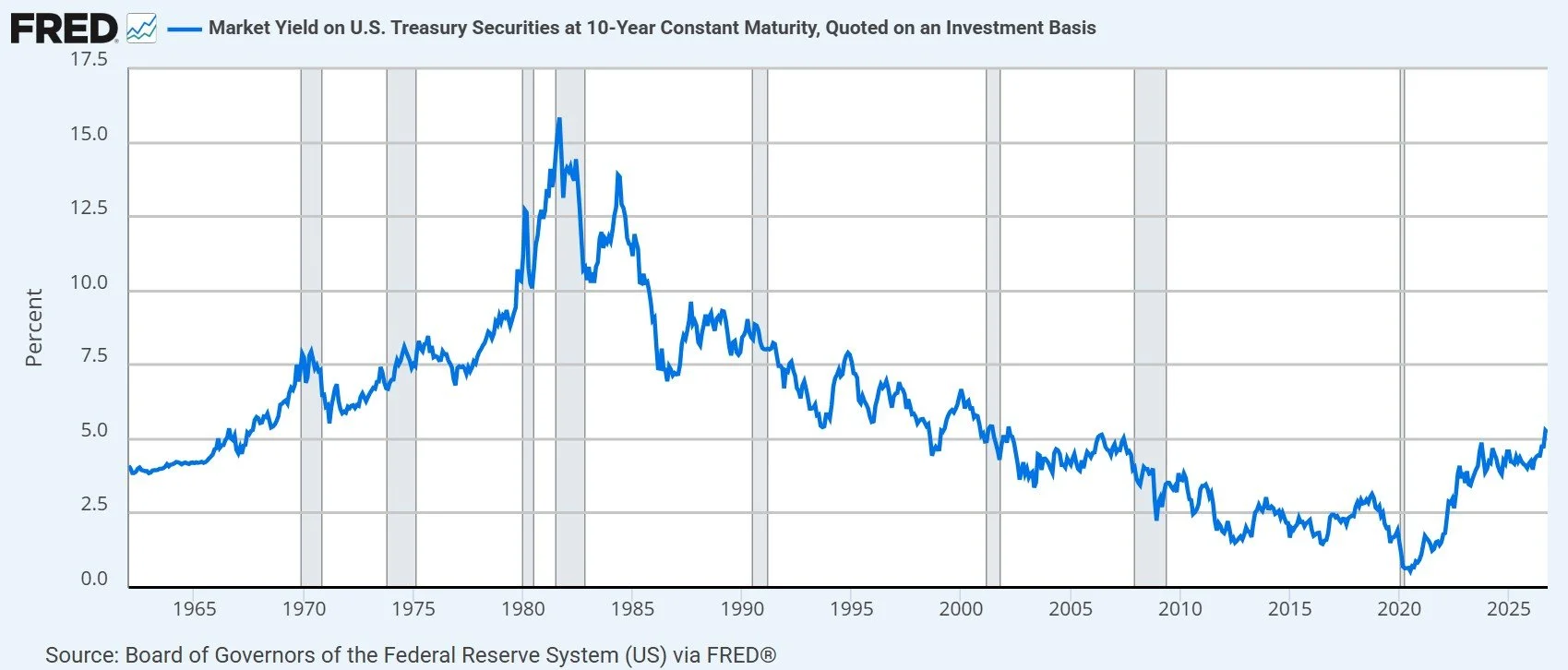
While this global benchmark is still low on a historical basis, the trend towards higher rates is undeniable.
· The US would guarantee global security. The US military, dominant since the end of World War II and especially since the end of the Cold War, was the real force that ensured seas were patrolled, security blankets were sufficient, and economic growth globally would be the beneficiary. Democracy was also hoped to be a byproduct here, but has a much spottier track record. With the Trump Administration bullying allies into spending more on their own domestic defense, the US absence on the seas, in Europe, and elsewhere removes one of the strongest pillars of global economic growth in the last 80 years. Who (or what) fills that void remains to be seen.
· Wide access to the US dollar. The US dollar has enjoyed the “exorbitant privilege” as the world’s reserve currency for decades and arguably still retains that designation despite competition from the Chinese Yuan, bitcoin, and other currencies. How much longer this privilege stays in place has been written about extensively and I won’t belabor it here. Countries wanted to and continue to hold US Treasury debt thanks to its perception as risk free. While the US has never defaulted on its debt (and I don’t think ever would), the largest economy in the world shouldering a $40 trillion debt burden where interest on the debt is now a larger budget line item than defense spending continues to give finance ministers indigestion. Everyone is looking for a US dollar alternative when none really exists. Additionally, the US dollar is now a tool of geopolitical leverage, through means such as sanctions and access to clearing networks like SWIFT. Iran, Russia, and other countries that run afoul of how the US thinks the world should run have found this out firsthand.
· Just-In-Time inventory management took precedence over Just-In-Case, or supply chain efficiency took precedence over supply chain resilience. Capital allocation under a globalized trade network was designed to minimize costs, maximize profit, and grow at all costs. Perhaps no economic shock better exposed the fallacy of this thinking than COVID when the West woke up to the fact that one country, China, has spent the previous quarter century building supply chains to dominate multiple sectors of the global economy with plenty of excess capacity to boot. Supply chain restructuring is underway in the West, but it will be years before any significant fruit is borne.
It’s worth clearly stating that this Old Order was very, very good for financial assets such as stocks and those lucky enough to hold them and not so good for physical assets or labor. Low wages wasn’t an accident, but instead was the globalized economy working as designed. It was this design that set the stage for widening income inequality and the K-Shaped economy phenomenon.
The Three Breaks
The old order didn’t end at once but was exposed by at least three events, or breaks, that have brought us to where we are today.
The first break was really one of legitimacy – the GFC in 2008. While the mechanics of the global economic system did not end in 2008, the blind belief in them did. Phenomena like Occupy Wall Street and the fact that no Wall Street executives were held accountable for bringing the global economy to the verge of a depression were cases in point. Taxpayer-funded bailouts of banks largely responsible for this global economic calamity were the salt in the wound and set the stage for today’s K-shaped economy. The medicine for this heart attack – quantitative easing (QE) was terrific for financial asset prices while globalization kept a lid on wages. Income inequality was the result.
The second break was the COVID pandemic. While the response to the GFC was focused on saving the banks, the fiscal response to COVID was to put money directly into the pockets of consumers and businesses in an effort to maintain spending in a US economy dominated by the consumer. This laid the groundwork for the end of the low interest rate era as the flood of money into the US (and global) economy inflated goods prices and wages. One of the results is sticky inflation in the US that has been above target for over five years.
The third break isn’t a single event but is the willingness to weaponize sacred cows. Specifically the weaponization of the US dollar. While not a new phenomenon, the willingness of those in Washington DC to literally kneecap other economies by restricting access to US dollars has forced a rethink in Tehran, Moscow, and Pyongyang, but also raises eyebrows in friendly capitals. If the US is willing to use the dollar as a weapon against a country that doesn’t toe the line what would stop it from making and following through on similar threats to allies? There is a reason that gold and silver touched all-time highs recently and it isn’t your typical supply and demand argument.
There are, to be sure, other events or breaks which deserve a mention including Brexit, the wars in Ukraine and Iran, and both Trump Presidential elections. I would argue that the Trump elections are results of the breaks discussed above. The fallout from the GFC gave voters the impression that bad behavior on the part of “the elite” on Wall Street could go unpunished. After asset prices rebounded sharply thanks to the Greenspan/Bernanke Put, this distributional failure only cemented the idea that capital owners were above the law, and Donald Trump was the result – twice.
Sticky Inflation and the Rate Problem
A big challenge for governments is balancing deficit reduction while undertaking massive spending plans to reindustrialize and reshore supply chains. Reindustrialization creates policy tension and needs loose monetary policy/low rates to succeed in that a lower cost of capital boosts investment returns. As mentioned, the COVID response was aimed at keeping the US consumer spending and the economy out of a recession. This was accomplished, but at a cost of higher domestic inflation as measured by the consumer price index. Industrial policy is inflationary (especially with the US economy at full employment). While the Department of War, for example, lends and grants hundreds of billions of dollars to kickstart critical material projects, the Federal Reserve must fight these inflationary activities by raising interest rates – raising the cost of capital for these capital-intensive projects. Do you see the problem? One arm of government is adding inflationary pressure by funding infrastructure, and another arm of government is trying to suppress inflation through monetary policy adjustments. Tighter money is self-defeating in that a long-lived mine or smelter is sensitive to interest rate movements in the way a software platform isn’t. The reindustrialization buildout in the US will only happen with these mechanisms (funding, price floors, etc) which, by their nature, are inflationary. The resulting policy mismatch is the result – governments wanting productive capacity for national security reasons, while the economics of a project (a lithium converter, for example) may not generate the required return needed to initiate the buildout. A higher cost of capital is the natural consequence of the need to reshore critical mineral supply chains. Oddly, an unfixable $40 trillion deficit doesn’t seem to be the biggest issue here. The issue is the true cost of capital in this new order. Increased demand for critical materials from defense and industry, higher input costs due to choked supply chains and wars, and resource nationalism all appear to substantiate my claim.
Consequences for Asset Owners
Obviously, these forces all imply significant investment implications. While the cyclical nature of critical materials isn’t going to change, how one invests must be re-evaluated given what I’ve laid out. Higher cost of capital is not as impactful for a brownfield mine or smelter but has significant implications for a greenfield project that is dependent on sustained robust pricing. Historically, capital was raised and allocated based on a project’s potential ability to generate cash and produce goods at a globally competitive cost. In the new order, security of supply, partnerships, and government support are now the sine qua non of Western critical material project selection.
This is why we have seen so much emphasis from Western governments on funding projects – the “China price” has been the number that drives returns. The country dominates so much of the supply chain from mine to market that a higher cost of capital only impedes capital allocation here implying low (or negative!) returns. If supply capacity doesn’t get funded and built in the current environment, no additional supply materializes in the future, and China still dominates. Subsidies are an unfortunate necessity.
With apologies to Adam Smith, the Invisible Hand is irrelevant in the new order and the sooner capital allocators accept this, the better. Subsidies such as price floors, off take agreements and grants and loans determine who builds projects and where they are built. Government support doesn’t necessarily fill a structural supply deficit but does allow Western producers to earn a return above the higher cost of capital. This essay and the ones that follow aren’t designed to pick winners – either via commodity or company – as they are all subject to these same challenges in the new order. Earning an “acceptable” return requires many of the same criteria as before (top tier management, high-quality asset, structural supply deficit, etc) but must accept government as a partner.
The Bear Case
With critical materials desperately needed in the West and governments fully behind this reshoring push, one would think that there is a “critical materials put” in place in the same way many investors came to believe that the “Greenspan Put” was in place to protect equity markets from falling too far, too fast. Any investment thesis deserves an analysis of its inverse and critical materials is no exception.
One of the core arguments is that interest rates stay structurally higher, which raises the cost of capital and lowers returns on greenfield projects. While this appears to be true based on five years of CPI data, interest rates in the 1970s were much higher than today and preceded a 40-year bond bull market, so regime changes aren’t necessarily a given. Additionally, the impact of AI (to be discussed in a subsequent essay) could eventually deliver the promised productivity gains to the global economy, keeping a lid on rates and raising wages without stoking inflation.
Second, demographics (covered in the next essay) would seem to favor secular stagnation and lower rates in the future as major economies continue to slow their population growth though, as I’ll demonstrate, this is a debatable premise.
Third, China continues to manipulate and in some cases flood critical metals markets, depressing prices and contributing to oversupply, decimating Western mine and refinery economics.
Fourth, the bond vigilantes appear in the form of much higher government bond yields, forcing governments to prioritize budget deficit management over fiscal expansion to the detriment of the reindustrialization thesis.
Fifth, trying to fund and manage projects with twenty year lives against a four-year election cycle is difficult regardless of the macro backdrop. The possibility that a post-Trump presidential administration changes or undoes some of the policies in place does exist, however unlikely. Combatting Chinese dominance in critical metal supply chains seems to be one of the few bipartisan issues in Washington DC these days.
The next essays in Act I will dive deeper into why the world has changed. The next essay will look at the effects of demographics.
Act 1, Pillar 2: Demographics as a Demand Driver
The grand bargain that underpinned economic growth in the West is breaking. The promise was that if you worked hard, you could own a home, raise a family, lead a comfortable quality of life and retire and leave something to your heirs. This model rested, in part, on favorable demographics: a society continuing to grow both organically (more babies being born), an expanding labor force, and immigration.
We are now learning what happens when the demographic tailwind disappears and the grand bargain reverses.
Demographics in most of the West (and China and Japan) has gone in reverse. The consequences are wide as demographics directly influences economic growth rates, labor availability, inflation, and even demand for critical materials.
A central tension is the result. Dependency ratios are rising, implying that the demographic dividend which underpins economic growth is in danger. An aging population can lower economic growth and consumption which can lead to lower prices and interest rates (classic deflation). On the other hand, a smaller labor pool means fewer workers which enhances worker bargaining power (classic inflation). To complicate matters slightly, more worker leverage can accelerate investment into automation, possibly reducing the need for human labor. An aging population doesn’t necessarily mean fewer workers in absolute terms but does introduce fiscal pressures (funding Medicare and Social Security) which have no easy or apparent remedies. Again, this is not a phenomenon unique to one country.
For investors, the second point is important. If fewer workers are needed to support the economy, productivity gains are essential. While automation is one solution, this requires copious amounts of capital, new infrastructure, and raw materials – typically critical raw materials. Critical materials underpin this automation and so access to them is not optional.
The Rate of Change
To start, what is important to remember is that the age level isn’t the most critical piece of data, but instead the rate of change of age. In other words, how quickly or slowly is a society aging? While the charts linked here and in the Appendix show relatively uniform aging across many societies, it is China that is notable. With the working age population shrinking, this undercuts one of the country’s competitive advantages, namely it’s deep well of labor. So as China’s labor pool shrinks, the single most powerful reason for low-cost goods in the West (offshoring and labor arbitrage) looks to be ending. While moving manufacturing operations to other low-cost destinations such as Vietnam is a possible solution, no country can match China’s scale.
This introduces a fascinating debate around what happens on a macro scale when powerful inflationary forces (such as decreasing labor availability) crash headlong into powerful deflationary forces (such as automation). Overall, the deflationary case vis-à-vis demographics is currently the most widely believed. With an older population altering consumption patterns, this can keep a lid on inflation as lower consumption leads to lower demand, higher savings, and lower interest rates. Japanese economic performance in recent decades is an example.
The inflationary case is more interesting as it’s not as intuitive. The best primer on why inflation rather than deflation is the direction of travel was written by Charles Goodhart and Manoj Pradhan, titled ‘The Great Demographic Reversal’. The central claim of the book is that the forces that led to decades of disinflation (China’s entry into the global economy and Baby Boomers in the workforce producing a labor glut) could have only happened once and is now in reverse as China ages and 10,000 Baby Boomers reach retirement age each day. It was this labor glut that kept inflation at bay and delivered the “goldilocks economy”.
The elderly then become consumers rather than producers and labor becomes scarce which enhances bargaining power, pushing up wages and fomenting inflation in the economy. Healthcare begins to account for a larger portion of the economy, is labor-intensive, and resistant to productivity gains. While I have always been in the deflation camp, I find this line of argument around inflation compelling and difficult to refute.
There is a deflation argument here with respect to aging societies and it rests with automation and technology. Those goods that can be manufactured by leveraging robotics hold the promise to counteract the possible inflationary forces unleashed by healthcare costs in an aging society. Which force “wins” is fodder for a robust long-term debate.
This is not a new phenomenon and historically when labor is scarce or expensive, capital comes to the rescue to build automation. Perhaps a positive takeaway for resource investors here is that automation is resource intensive. Enormous amounts of copper, lithium, rare earth magnets, and other materials are needed to bridge the gap between scarce labor and automation. If labor remains scarce, capital must come to the rescue to automate activities that go unfilled.
So, the “flow” looks something like this:
Aging society –> labor scarcity –> automation –> materials and energy demand
Viewed through this lens, demographic changes look to be an accelerant to critical materials demand. It is important to remember that the economic forces behind inflation and the economic forces that determine demand for critical materials are not the same. While automation could be deflationary as it increases output at lower cost, significant investment is needed to build the infrastructure supporting automation which would be inflationary in the near-term. Investment demand, productivity, and substitution all impact this debate in different ways.
A Brief Note on Politics
Immigration is a force that can help defray the impact of an aging society, but its impact depends on how much immigration occurs and how quickly. Immigration in the US has been the rocket fuel for economic growth in the country for decades and so the current political climate around this issue is disheartening. Talk about cutting off your nose to spite your face. Without adequate immigration, labor availability remains in question, and the inflationary winds continue to blow.
The Bear Case
There are some reasons to be wary of the inflationary consequences of deteriorating demographics.
First, should automation and AI permeate through society faster than the labor pool shrinks, the aging threat could be deflationary after all as the much hoped-for productivity miracle arrives as promised. Stable economic growth underpinned by healthy wage growth and widespread access to transformational technology is a policymaker’s dream scenario.
Second, there isn’t a good case study of an aging society producing inflation that I could find. Japan has, by most accounts, failed to ignite any inflation in the domestic economy despite decades of trying.
Third, the politics of immigration could reverse course and increased flow of labor across borders keeps a lid on any inflationary impulses. How likely any (or all of these) are is up for a rigorous debate, but in the interest of a balanced look at outcomes, they each need to be considered and handicapped.
Fourth, there is a possibility that inflation and deflation co-exist. As mentioned earlier, automation can be deflationary in an economy over the long-term through increased productivity while the buildout of the infrastructure needed to support the automation is inflationary due to substantial investment in raw materials, etc.
Given that these essays all involve AI in some way, harnessing the oncoming freight train of this technology could be viewed as a necessity rather than a “nice to have”. If populations shrink and grow old, productivity growth is an important solution to growing an economy with less available labor. Thus, building AI infrastructure and harnessing the technology becomes vital to maintaining a viable standard of living. The thesis here on demography is compelling, but the true implications for critical materials demand will depend on the rate of change of aging as well as how quickly automation technologies are adopted.
The next essay in this series will focus on the automation imperative.
Act I, Pillar III – When Asset-Lite Gets Heavy
The continued rollout of AI into our lives is likely to introduce a new technological paradigm. The long-term benefits are still to-be-determined and despite some of the legitimate concerns about the technology and the economic benefits, AI continues to improve. One thing is certain: the AI buildout will require an enormous amount of resources.
AI is a story about access to power and compute. The constraints we hear about are not technology-based, they are physical. Building the necessary power and compute infrastructure is both capital and resource intensive. Electricity, grid infrastructure, semiconductors, and the raw materials all get you to the starting line. No copper, no power. No lithium, no grid-scale storage. No scandium, no solid oxide fuel cells, and so on. Multi-year waits for gas turbines and backlogs for semiconductors are but two examples of near-term constraints on the growth rate of AI.
In tech cycles of the past, but of this new economy was built around low-marginal cost software. The AI buildout is almost the opposite. As mentioned above, access to the physical tools gets you to the starting line.
This raises a question for investors: which companies are best positioned to capture the growth, and which materials and infrastructure are requirements rather than “nice to haves”? Each question can run amok and turn into its own bubble – a significant concern in the current AI buildout where hundreds of billions of dollars are planned to be spent in the coming years. Complicating these questions slightly is also the fact that AI profitability and returns on AI infrastructure are different.
The basic premise of this Pillar is that the AI buildout and subsequent proliferation throughout the economy could backstop significant demand for resources. Whether or not that demand results in solid investment returns depends on a host of factors including capital intensity, cost of capital, and structural supply constraints.
The US-based large language model developers (LLMs) such as OpenAI, Google, or Anthropic aren’t the only companies racing to build AI infrastructure at scale and the rise of China-based open-source models has led some to view AI as an arms race. It isn’t likely that one of these companies can outspend the other to win in the same way as the US outspent the USSR during the Cold War in a different type of arms race.
Overspending on power or compute infrastructure could lead to ruin as spending gets too far ahead of sustainable revenue. Though some of the LLMs are not public, they are believed to be highly unprofitable during this stage of their growth.
So, there are likely two trades here for investors: a tech trade to bet on which LLM will emerge (relatively) unscathed from the inevitable boom and bust cycle and a resource trade to bet on which raw materials and infrastructure will be most needed as the AI buildout continues.
Historically, the tech trade and resource trade were opposites – tech was a great deflationary impulse and a reason why hard assets underperformed. Hard assets typically thrive in an inflationary environment, and the proliferation of tech put this trade to bed more than once. This relationship has now inverted, and it is resource demand taking precedence over tech. The previous tech investment cycles were capital-light. The AI buildout is anything but with it running on copper, steel, natural gas, and a host of other materials. Access to power and raw materials increasingly determines the pace of growth.
Access to compute is a story about power which is physical. Nvidia’s market capitalization of $5.5 trillion is the market betting that this company will continue to grow through the cycle based on its technology which is in part underpinned by a resilient supply chain. Resilience will also be discussed in Act II as a constraint.
From the 1990s onward, the appeal of tech investing has rested on the fact that software was zero marginal cost and Moore’s Law would continue (though not indefinitely). This investment model was capital-light, low-commodity intensity, and high return on invested capital (ROIC). The era of digitization and investment in bits took precedence over investment in atoms.
What Happened?
As AI has expanded its reach, computing economics has changed. Investment in cutting edge technologies depends upon a number of issues including speed and scale of deployment once the tech is developed. As Moore’s Law continued to slow down, this necessitated either new technologies or rethinking tech architecture to “squeeze more juice out of the lemon”. This can increase the bill of materials as a change in workflow or supply chain dynamics can cost both time and money.
A data center is more than four walls and a roof. It is an enormously complex ecosystem of power, cooling, and energy distribution. Semiconductors, the most discussed piece of the datacenter architecture are a minimal part of the footprint. The need for the raw materials to complete a datacenter buildout is what matters. While chip performance may continue to improve, implying a reduction in the resources needed to produce an equivalent unit of compute, overall resource demand can still increase – Jevons Paradox for all to see.
Many refer to the Microsoft study from 2009 that stated a data center requires 27t of copper per MW of capacity for power distribution. Beyond copper, electrical steel, gas turbines, gallium, germanium, silicon carbide, gallium nitride, lithium, nickel, rare earth magnets, and water are an incomplete list of resources and infrastructure to turn a data center from a plan into a working, scaled operation.
The scale of this buildout is in some ways not unique in history with many comparing it to the railroad boom in the 19th century or internet boom in 1999-2001. These booms were capital intensive, put huge pressure on resource demand, and laid the groundwork for productivity booms, though only after incinerating much of the capital that went into creating the boom in the first place. Will the AI datacenter investment binge play out the same way? The market consensus is yes. Therefore, the main risk for investors is thinking about the speed of deployment here and how resource-intensive each piece of infrastructure is. Less can be more, but you better have your analytical insights trained on the right part of this supply chain.
The previous essay concerned demographics and its impact on growth. If multiple companies and countries around the world are devoting greater and greater sums of CAPEX to try and win the data center race and ignite a productivity boom, the resources which underpin this investment move become both an investment and policy priority. This is one of the reasons why the US government has been so aggressive in funding critical materials projects. This support in the form of off-takes, grants, loans, and equity investments can both reduce financing risk, crowding “in” private capital and help with chart a path to profitability.
Governments have been instrumental in helping the private sector develop technologies that have benefitted citizens as a whole including GPS and the internet. So, governments funding critical material projects, semiconductor fabs, and other infrastructure projects is déjà vu all over again to quote Yogi Berra. Whether or not AI works as advertised isn’t entirely what matters. Producing and supplying the raw materials needed to make AI generate a productivity miracle is what generates above average returns. Success in this mission will come through public/private partnerships where capital allocation and risk are shared across the capital stack.
Second Order Demand Drivers
Despite the attention the datacenter buildout receives, there is no shortage of additional demand drivers underpinned by technology that bode well for critical material demand. These include automation and robotics, defense and autonomous systems, and all sorts of AI applied to mining tech such as predictive discovery. While demand on a per unit basis for magnets, for example, in a humanoid robot may not be significant, collectively these totals can add up quickly. Exogenous factors such as Chinese export controls on materials and magnets has artificially pushed up ex-China pricing, forcing supply chain managers and government officials to try to rapidly fix a tenuous situation that can only be fixed in a timeframe measured in years.
The Bear Case
The basic pitch here is that the AI data center build out is particularly resource and energy intensive. What could derail this thesis?
First, could more efficient compute or algorithms reduce infrastructure demand? Doing more with less has been a hallmark of technology. More efficient chips, better architecture and smaller models could help build a more efficient, and smaller AI ecosystem. Another way to think about this is that Jevon’s Paradox could fail to deliver. For those unaware, Jevon’s Paradox states that as a technology improves and increases the efficiency of use, the total consumption of that resource rises, rather than falls.
Second, the overbuild thesis comes true. Think of the 19th Century railroad boom or the dot com boom and bust in 1999-2001. Capacity simply runs too far ahead of demand.
Third, circular financing. Do vendor financing and related-party transactions imply demand that simply doesn’t exist?
Fourth, strong demand may not result in above-average returns for investors. Fierce competition, excess capacity, and falling prices could lower returns across the supply chain. With respect to raw materials, supply expanding faster than demand, an unfortunately common occurrence, could push resource prices down. This may be good for end users, but force producers to make difficult decisions as operating at a loss is not sustainable.
The AI buildout underway has few parallels in economic history. It is likely to play out as a traditional boom and bust cycle and the companies and infrastructure that emerge from the ashes will be particularly well-placed to succeed.
For critical materials investors, you must gauge where the structural constraints on growth exist and find those companies that can earn returns in a highly cyclical environment.
The next essay in this series will explore the Weaponization of Everything.
Act I, Pillar IV – Weaponization
In 1996, New York Times Columnist and foreign policy thinker Thomas Friedman made the claim that no two countries with a McDonald’s had ever gone to war. He also claimed that ‘the world is flat’. Both claims have proven to be false, however, there is nuance here.
While we have learned a great deal about how the global economy functions since those claims, perhaps the biggest lesson is just how interdependent and intertwined the global economy really is thanks to decades of globalization and supply chain optimization. Perhaps the most unpleasant surprise to policymakers is that just as it took decades to make the global economy so intertwined, it may take just as long to “untangle” trade links – supposing this is a good idea, which I don’t think it is. Disrupting this means taking a huge political risk and no policymaker wants to seriously jeopardize their career by getting in front of this freight train.
The pursuit of the lowest cost of production led to concentration of supply chains in many cases. While low-cost goods for consumers were a byproduct of this phenomenon, supply chain optimization has led to more, not less geopolitical competition. Initially, economic policy tools such as tariffs or sanctions were leveraged and this has now expanded to actual goods such as magnets or semiconductors becoming weapons to be wielded by the country that controls that specific supply chain.
These are the building blocks of future economic growth and social stability, so it’s not a surprise. What is surprising and somewhat confounding is the end game which, at this point, is anyone’s guess. Once a vulnerability has been discovered and a chokepoint has been leveraged, it may be impossible to put the genie back in the bottle.
Framing interdependence
Perhaps the best frame for this argument is Henry Farrell and Abraham Newman’s Weaponized Interdependence. In this seminal piece, the authors state the opposite of Thomas Friedman’s argument. The world is not flat. It is, in fact, a series of hubs and spokes with the hubs being crucial to economic leverage. Owning a hub means knowing what flows through it (magnets, raw materials, etc) and where it ends up. It also means you have the leverage to stop the flow of a good to those in need. If what I’m describing sounds like the rare earth magnet supply chain, then you can clearly see why the theory is so powerful.
In the same way the US effectively “controls” access to the US dollar and clearing networks such as SWIFT, China’s control of much of the midstream piece of critical material supply chains is the mirror image. This is the economic game of chicken we find ourselves in today.
Escalation Visualized
Before looking further into why this weaponization of everything may be irreversible, a timeline, or ladder of events that brought us to this point is useful.
Here’s a link showing how more and more goods became weapons, how, and against whom.
What is notable here is that the menu of what can and is ultimately weaponized continues to expand. Also, this isn’t just a “good guy versus bad guy” tit-for-tat. The Trump Administration has been more than willing to threaten allies with the same weapons used on adversaries. Weaponization was once a last resort. Now it’s an opening act in any negotiations and why it is a new phase in the new order introduced in Act I.
What Does a Chokepoint Look Like?
A chokepoint is like pornography – you know it when you see it. But perhaps defining the term is required since chokepoints can take so many different forms. There are at least five factors to consider when assessing a chokepoint:
1. Location – Where on the supply chain does the chokepoint sit?
2. Substitution – Can the chokepoint be substituted for a more readily available good at a suitable price?
3. Time to replace – Supposing substitution is a possibility, how long will this take? Months? Years?
4. Concentration – How much of a supply chain is controlled by a single country or company?
5. Cost – What costs (economic, political, social) must the recipient of the chokepoint bear?
Chokepoints have evolved and financial chokepoints and physical chokepoints behave differently. A financial chokepoint (US dollar access) can be implemented and restored faster than a raw material chokepoint (rare earth permanent magnets, refineries). So, any leverage exercised over raw material supply chains is necessarily longer-lasting – but not indefinite.
Why is it so difficult to untie this knot?
Countries that demonstrate chokepoints are like magicians that show the audience how they do their tricks. Once you’ve seen it, you can’t unsee it. While policymakers in 2020 may not have been aware of Chinese dominance in rare earth permanent magnet production, they absolutely are now.
The natural solution is to raise and deploy capital to mitigate any dependencies. While this makes sense, most supply chain managers are loath to go this route given unfavorable economics and the sheer amount of time it takes to rebuild a supply chain. Multi-year capital commitments for long-lived assets like mines or refineries are difficult to justify when most Western companies are fixated on next quarter’s results. Hence the need for Federal involvement in any supply chain rebuild.
So, there are costs associated with both action and inaction. Weaponizing chokepoints invites retaliation and escalates both the implicit and explicit costs of doing business. Weaponization is not irreversible as political winds can shift rather suddenly. What doesn’t fade is the threat. This could explain why investment ramifications could outlast the possibility of suffering the threat of a chokepoint. Building and operating long-lived assets such as mines or refineries takes time and capital and in order to generate an acceptable return, must run at capacity. Any interruption here and economic value is destroyed. Large infrastructure assets can’t simply be shut off in the same way a tariff can be removed. The investment and political cycles aren’t synched and this can create uncertainty in investment targeting.
The Bear Case
There are at least four reasons the bear case needs to be considered.
First, trade fostered by globalization has proven to be resilient. Change is hard (and expensive), so companies adapt rather quickly. Interestingly, despite a multi-year trade war on a global basis, trade values continue to increase. In 2024, the WTO reported that merchandise trade volume increased by 2.9% and the dollar value of that trade rose to $24.4 trillion. Trade can continue to grow while those trade links and patterns are rearranged.
Second, the effectiveness of export controls is doubtful. Export controls of goods like advanced semiconductors are designed to keep this cutting-edge technology out of the hands of adversaries. While it looks like this policy is negotiable on the part of the Trump administration, these controls often accelerate indigenous innovation of the same good.
Third, as we have seen in the US, policies can reverse within a political cycle and with political cycles shorter than mine or refinery lives, it is difficult to make a huge financial bet when policies are deemed to be fickle. Investment horizon is critical.
Fourth, the old investing adage applies here: nothing cures high prices like high prices. Scarcity premia may sow the seeds of their own destruction unless the economics of a project can be supported at lower-for-longer prices.
We now turn to Act II and look at constraints.
Act II - Constraints
Introduction
Act I in this series of essays attempted to lay out the case that the global economy is entering a higher-cost world due to the lingering effects of different events including 9/11, the Great Financial Crisis, COVID, the return of inflation, and deglobalization resulting in fragmented supply chains. Supply chain resilience is an attempt to insulate against these shocks, and Act II examines the costs and constraints these place on investors. Act III will examine who can capture excess returns in this new environment.
The five pillars of Act II are supply chain resilience, energy and power, capital and time, labor, and resource nationalism. While there is certainly a case to be made for other constraints, these five form a solid foundation upon which investors, legislators, and company management can gauge and mitigate risk while also building a sufficient model for growth.
If the macroeconomic landscape has permanently changed, then supply chain resilience is not a “nice-to-have” but instead is a requirement; a “must have”. Everyone likes cheap stuff and for four decades, companies and governments aligned to make sure supply chains were positioned to accomplish this through offshoring, keeping lean inventory, outsourcing manufacturing, and labor arbitrage. This was not foolish (at the time). It was widely believed that free trade would open markets and the interdependence that would follow would reduce the potential for conflict. Political risk was assumed to be nil under this scenario as it gets in the way of maximizing profits.
Act I was the story of this assumption being incomplete. Act II is the story of the costs of rebuilding supply chains to mitigate risks in this new reality.
Supply chain resilience is permanent and high cost. The goal of resilience isn’t to simply build more infrastructure and redundancy. The goal is to build to a scale that makes economic sense, in a reliable jurisdiction, and at an acceptable cost for all involved. Investors, policymakers, and company management must all adjust to this reality.
Act II, Pillar 1 – Chasing Resilience
The Cost(s) of Resilience
It’s one thing to pay lip service to supply chain resilience. It’s an entirely different matter to commit and deploy capital in rebuilding existing supply chains to hedge against vulnerabilities. These vulnerabilities include reliance on one country or company, opaque pricing, or economic tools such as tariffs. Costs and benefits run through a handful of criteria. These criteria are included below with associated drawbacks:
· Multiple Suppliers – Less scale and smaller overall volumes from multiple suppliers. Qualification timelines and costs may increase.
· Geographic Redundancy – Duplicated assets may run at lower capacity utilization.
· Traceability and Provenance – Added compliance overhead. Who pays for this?
· High-Cost Locales – Moving supply chains closer to end markets implies higher costs for labor, permitting, and ESG compliance.
· Hedging Price Risk – Assuming this is possible with numerous components and raw materials beset by opaque pricing structures and illiquidity, costs could be significant.
· Qualification Cost and Timeline – Product qualification can take 24-to-36 months. Rebuilding supply chains resets the clock here. This point is further developed in Act III.
This last point is why reshoring and resilience don’t happen overnight. Supply chain managers are loath to duplicate any aspect of a functional system due to the threat of structurally higher costs and a lengthy qualification timeline. Time is money, as they say.
Resilience appears on the balance sheet. Whereas previous supply chain dynamics focused mainly on cost control, duplicating infrastructure, inventory, and impacts on working capital are all a part of the higher structural cost thesis with building resilience into supply chains. Managers need to weigh the cost of preventing an occurrence with the cost of weathering a specific event.
Shouldering the Costs
If resilience involves duplication, it is inherently inflationary. The costs aren’t necessarily borne by one individual or group; they’re shared. The rebuild of infrastructure, while good for GDP growth numbers, does have the potential to push up prices and sets the longer-term cost of doing business higher than before. Throughout my time as an analyst in the critical minerals sector, doing side-by-side comparisons of infrastructure built in China and built in the West shows how uncompetitive it is to set up shop ex-China. This higher cost is borne by one or more of three separate entities:
· The consumer
· The supplier
· The Shareholder
Increased costs are all eventually paid and cannot be wished away. A consumer pays through higher prices. A supplier pays through tighter profit margins. A shareholder pays through reduced returns, which can be the result of a company not having adequate pricing power to match increased input costs.
Typically, the impact of increased costs is shared between a producer and its lower-tier suppliers to minimize the “hit”. An automotive manufacturer tells its suppliers to not raise prices, and this is one of the reasons why the mid-stream of Western supply chains is commonly referred to as “the missing middle”. If these lower-tier suppliers must eat increased costs, it can serve as a threat to their businesses and deliver poor returns at best. Supply chain fragility is the result. Thus, vertical integration is thought to be a panacea but may not be a cure all. Again, the trade off here is to find a supply chain model that balances adequate resilience at an acceptable cost.
There are two implications of playing hot potato with a structurally higher cost operating environment.
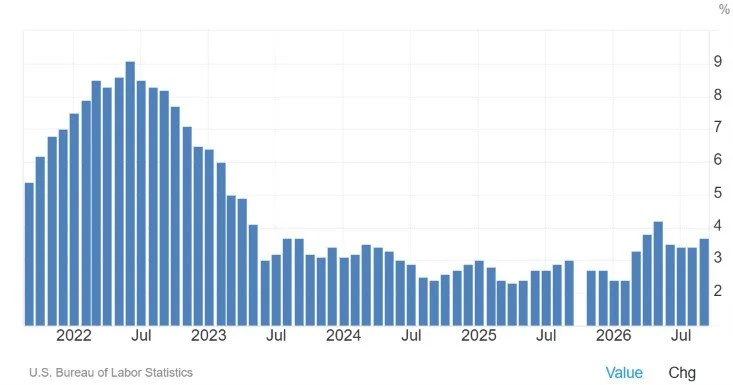
First, inflation becomes sticky, a concept first mentioned in Act I. If all companies are pursuing supply chain resilience by duplicating infrastructure, holding more inventory, and purchasing from multiple ex-China sources, structurally higher costs are a given until a mix of scale, labor bargaining, and technological innovation can perhaps come to the rescue. In the interim, think of this as a permanent price shock which changes where supply and demand equilibrate in an economy. The chart below of US CPI shows how entrenched inflation has become despite falling precipitously from the peak during the Biden Administration.
Second, productivity, or more specifically total factor productivity (TFP) takes a hit as redundancy implies lower capacity utilization. As a manufacturer, your consumer market is stable, but you’re operating double the capacity in the name of resilience to make sure your suppliers can’t cut you off from the inputs you need to operate. This is the leverage China continues to exploit over the world economy.
Stockpiling as a Safety Measure
Stockpiling critical raw materials is nothing new. The US was a major stockpiler of critical metals during World War II and even today entities like the Defense Logistics Agency is involved in scouring the globe for metals necessary for national defense.
Stockpiling is not the same thing as true supply security. It is thought to be a cheaper alternative to a full redundant rebuilding of supply chains and that is almost certainly true. The challenge here is that many of the metals that Western countries are looking to stockpile are concentrated in China. This begs an uncomfortable strategic question: why would China sell those metals or materials (rare earth permanent magnets are an example) to Washington in the first place? China, through the State Reserve Bureau (SRB) maintains its own stockpile and while sharing the wealth here, so to speak, might lower the geopolitical tension, it erodes one of China’s core advantages over the rest of the world. Other countries including Japan and South Korea have metals stockpiling programs and the EU is discussing this but has no formal program as of yet. In the US, Project Vault, a $12 billion plan to stockpile a host of critical minerals and work closely with trading firms and commercial entities as well, is a notable attempt and should start to bear fruit shortly. However, until Western critical mineral supply chains are built out and mature (and cost competitive) we will be sourcing material for Project Vault mainly from China.
Stockpiles can also create a market design problem. If price stabilization is the goal, purchases and sales should be made countercyclically, so as to buy low and release material into the market when prices are high due to a lack of availability. Currently, the West lacks this capability and one of the main concerns with stockpiles is the affect on pricing and price volatility. Many of the metals that need to be stockpiled such as gallium or germanium are tiny in tonnage and given that most production comes from China, the price mainly determined there as well. This raises the possibility that as multiple countries all pursue adequate amounts of metals that aren’t that big to begin with, pricing volatility will be the order of the day. The irony is that the whole point of stockpiling is to mitigate the price fluctuations by making the materials more widely available!
National defense is the most price insensitive of all end uses. The demands on product specification are incredibly strict and so while companies like Lockheed Martin would vastly prefer not to pay up for materials like tungsten or antimony, having the metals on hand is better than not having them at all. The objectives of the commercial market and the defense markets conflict in this regard.
Stockpiling is perhaps the most politically palatable choice to enhance resilience but doesn’t take the place of new mines or refineries.
The New Industrial Policy
Industrial policy is de rigeur in Washington DC and exactly how this should be structured and evaluated are up for debate. Under President Biden, industrial policy was focused on ESG and green inclusive growth. Under President Trump (both Trump 1.0 and 2.0) national defense and energy dominance are the investment themes. Fortunately, each thesis draws on many of the same critical materials.
Industrial policy rests on at least five pillars. They include:
· Demand signals such as price floors and binding offtake agreements which are designed to establish a revenue stream
· Supply signals such as grants, loans, and equity stakes designed to lower a firm’s cost of capital
· Trade tools such as tariffs or Section 232/301 investigations designed to protect domestic markets from unfair competition
· Permitting reforms such as FAST-41 designed to streamline the process and make it more predictable and efficient
· Strategic purchases where government demand can create nascent markets
It is early in the rollout of this new industrial policy approach and clearly the US government will be a major stakeholder in the success or failure. A lower cost of capital is ideal but is not a guarantor of a project entering production and generating mountains of cash flow – the ultimate measure of success. With apologies to Adam Smith, the Invisible Hand of the market is taking a backseat to the very visible presence and firepower of the US government. We won’t know for several years how successful this approach will be. Political will is crucial along with project execution and discipline.
Crowding In
Industrial policy in the West is unlikely to succeed unless both the public and private sector take part together. Wall Street needs consistent policy signals from Washington and Washington needs the deal smarts on Wall Street to execute deals that leverage and protect taxpayer money at the same time. The goal of the US government’s “bazooka” of capital, currently being fired at numerous critical materials projects, is to pair this with private capital from banks, hedge funds, or private equity firms. These investors are more likely to invest when the government capital has addressed a specific risk, be it technology, commercial, or something else. The paradox, however, is that if a risk is mitigated, this is likely to compress returns for private investors. It is important to remember that a subsidy does not guarantee an above average return.
Where Are Our Friends?
What about partnerships across borders? Resilience is not a national issue; it’s an international one. Does it make sense for individual country governments investing in domestic projects specifically with domestic capital providers? Of course not. This is another reason why I think true decoupling and reshoring is nonsense.
Countries “going it alone” is a recipe for excess capacity and poor returns due to capital chasing suboptimal projects. Duplicating capacity doesn’t get us any closer to competing with China. The goal should be to build resilient networks across borders where strategically necessary with trusted partners. This diversifies risks and shares costs.
Geology ensures that at least one part of a supply chain cannot be moved. But everything else downstream can be. There are examples of the US government funding both approaches (homegrown versus cross border) and while it’s too early to tell which model is superior, domestic vertical integration is still the preferred modus operandi as we have actual financial results to judge.
The Bear Case
It’s difficult to argue against self-sufficiency; especially in the wake of what we’ve seen from China flexing its critical materials muscle. The policy is easier to endorse than it is to measure and execute. There are reasons for caution.
First, how is resilience measured? Would lower percentage imports of select raw materials from China be a success? By dollars spent or inventory held? There has been no shortage of announcements on capital commitments, but how much of this government-funded capital has been deployed and generated a return? MP Materials deal with the Department of War is a lone example and has been a success, but what other examples can we point to?
Second, substitution, thrifting, and domestic recycling minimize dependence and are arguably more cost-effective than a full supply chain duplication. An entire mine complex may not be the optimal solution to a specific vulnerability. The availability of substitutes, qualification timelines, and the cost structure of a recycling operation all matter.
Third, policies in Beijing, Washington, and elsewhere can shift faster than infrastructure can be built. Asset lives of thirty years do not pair well with four-year election cycles or tariffs that can be implemented or revoked on a whim. Investors must be disciplined enough to separate projects that have strong economic viability versus those that are dependent on policy. Keep your fingers crossed that fighting Chinese mineral dominance remains a bipartisan issue in Washington going forward.
The goal is to build a system that is resilient enough to withstand the impacts of policy without duplicating capacity unnecessarily. Resilience is insurance and this insurance comes at a cost.
In Act II, Pillar II, we look at energy and power as constraints on growth.
Act II, Pillar II – Energy and Power
Given the focus on industrialization and resilience, governments’ newly aggressive approach towards funding projects has started to convince private capital that critical minerals supply chains are an opportunity that will require billions, if not trillions of dollars. That said, financing a project and achieving commercial production are not the same thing.
The most pressing binding constraint is energy and power. Power is measured in watts and is defined as the rate of electricity generation or usage. Energy is measured in watt-hours and is defined as the total amount of electricity delivered.
Project buildout and operation at scale rest on the assumption that reliable electrical infrastructure is available on demand to run these plants. Aging domestic infrastructure, long interconnection queues, and relentless demand for power from hyperscalers risk crowding out critical minerals funding that governments are actively encouraging.
Act I, Pillar III focused on technological acceleration and its dependence on physical infrastructure. This pillar will show why more energy infrastructure is needed to compete. It’s not enough to generate more electrons. We need to be able to deliver them reliably in adequate quantities at specific times.
This calls for an all-of-the-above approach regardingenergy access and infrastructure. Hydrocarbons, nuclear, renewables, grid-scale storage, and hydro will all be called upon to solve this problem.
The main challenge with critical minerals in the West isn’t one of access – decades of supply in situ have been located, delineated, and measured. Many will disagree with the idea that power is the binding constraint in critical minerals infrastructure, but with capital available, many projects under development, and government behind this reindustrialization push, an aging grid is a seriously overlooked vulnerability. Power is one of the most important input costs given its ability to limit project development and uptime.
Where Are the Electrons?
To reiterate, capital access is not the problem, electron access is. The ability to connect a project to the grid, transmit the power and secure equipment given the lumpy geographic demand for electricity are all unique problems that need a response. The electricity grid in the United States hasn’t grown in line with the broader economy and isn’t prepared for what is now happening with rampant demand for electricity from data centers and the broader economy.
This need is not a single technology problem and can be solved through a combination of capital deployment, planning, and time. Think of this as supply chain resilience within the electrical grid. If we want more aluminum, silicon, steel, or other metals, we need more electricity and the ability to deliver it. Without it, the entire reindustrialization thesis (not to mention the AI datacenter buildout) will be limited.
Recycling these materials is a partial solution but also requires electricity. This closed loop supply chain could reduce primary metal demand in the long run, but these constraints are hitting now, and we’ve already discussed the limitations of recycling infrastructure in the previous pillar.
Where Are the Grid Constraints?
One of the most interesting, yet daunting things about the electricity grid is its complexity. Projects often experience multiple delays along their supply chain. Shown below is a high-level schematic of how atoms in the ground end up as electricity and power modern life.
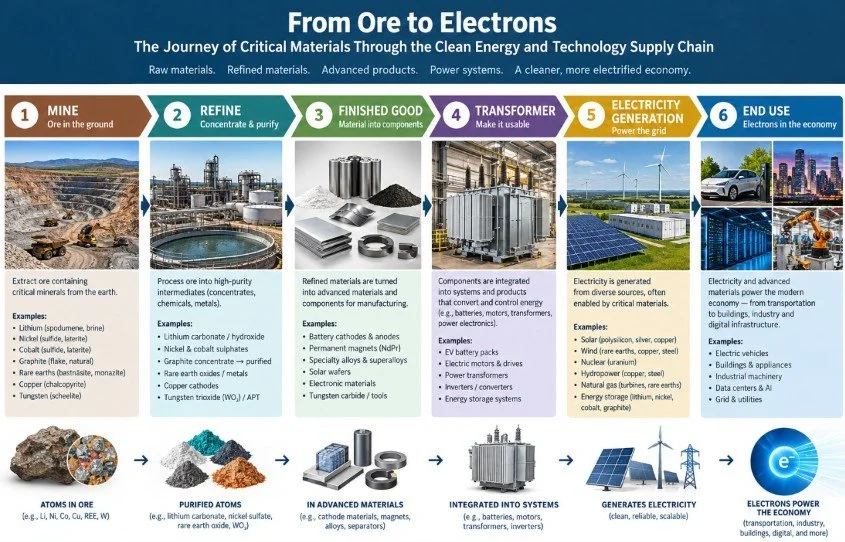
Source: ChatGPT
What is more important to understand is the queue to actually build more electrical infrastructure is backlogged. This is the true constraint on growth and is a multi-step process.
First, interconnection studies must be undertaken. These are conducted typically by grid operators or utilities and can last multiple years with a goal of understanding whether or not an existing grid can handle additional load and if not, what upgrades are required.
Second is transmission infrastructure. Think of this as high-voltage lines you see along highways or the substations. These lines are the conduit through which we access electrons. This process is also multiple years as cost allocation across different jurisdictions, siting, and construction costs are evaluated. Specialized engineering firms are contracted by utilities to build this infrastructure.
Third is the equipment such as transformers, gas turbines, and grain oriented electrical steel. This is a particularly critical part of the supply chain currently experiencing multi-year wait times.
Fourth is labor needed for installation and maintenance of equipment. Arguably available, but at an inflated price as datacenter construction has ensured this specialized craft goes to the highest bidder. A perfect example of the “sticky” inflation discussed in Act I, Pillar I.
The good news is that each one of these parts of the queue can be solved, but they must be solved in order. Throwing money at this issue isn’t enough; it needs to be done sequentially.
The Competition for Electrons
Both the data center and reindustrialization ecosystems are competing for the same access to reliable electricity. This is likely to continue as both require the same things: equipment, capacity, skilled labor, and capital.
An aluminum metal refiner can pay around $40/MWh before economics become untenable and hyperscalers can pay well above that (up to $115/MWh) and are doing so, highlighting why electricity access is a binding constraint in the critical minerals space. Compute is winning the race for the marginal electron by a wide margin.
The paradox is that the AI buildout is making the power to build infrastructure scarcer. While hyperscalers have shown willingness to pay whatever it takes to access electricity, this could limit the critical minerals buildout as these projects operate under a different economic profile and won’t move forward without reliable electricity access.
Behind-the-meter generation such as solar panels paired with batteries or on-site natural gas is a goal of both hyperscalers and metal refiners to supplement supply from the grid or avoid it altogether. This model has been used by refiners and smelters in the past, so it’s viable. This doesn’t obviate the need for more power but could be a near-term solution for multiple industries. Still, raw materials and infrastructure are needed for behind-the-meter generation, so this is only a partial solution.
Geography of Power
China’s supply chain advantages aren’t limited to a giant low-cost labor pool, state subsidies, or soft environmental enforcement. The access to cheap and reliable power underpinned by significant grid investment is a major strategic advantage. The IEA claims that power prices in the EU are 50% greater than those in China and double those in the US. The EU reliance on carbon reduction puts the region at a competitive disadvantage even though China continues to deploy enormous amounts of renewable capacity as well. Energy sourcing is an endeavor that requires attention to contract structures, labor availability, logistics clusters, and environmental sustainability. With power anywhere from one third to half of costs (cash) the West competing here would require significant and permanent subsidies – a politically divisive issue nobody wants to admit.
So, geography is a vital consideration for project viability. The province of Quebec in Canada (hydropower) and the US Gulf Coast (natural gas and existing infrastructure) are two prime examples. Access to cheap and reliable energy allows projects to cluster and flourish.
Who Foots the Bill?
Costs must be shared amongst all stakeholders. Utilities are likely to push added costs into the rate base which increases costs for consumers – a non-starter, especially in an election season. Hyperscalers, in an effort to prevent political backlash, have been aggressive in securing their own power with behind-the-meter strategies or by negotiating long-term contracts. This also adds the responsibility of managing their internal power supply chain. The cost of the power doesn’t disappear, but it shifts. Power externally purchased is an operating expense on the income statement. In general, when power generation moves behind-the-meter, this moves to PP&E on the balance sheet. A company is devoting high up-front capital to ensure security of power supply as opposed to relying on an external provider. It’s a trade off, but given what’s at stake, the hyperscalers seem willing to do it.
A final question is on timing. How does a company underwrite a mine with a multi-decade life when operating economics are dependent on power contracts, tariffs, and a regulatory backdrop that can adjust sooner? This timing mismatch requires investors to make bets around the sustainability not just of infrastructure or materials demand, but also on the sustainability of policy.
The Bear Case
Perhaps the optimists are right and cheap, clean, and abundant energy is on the horizon. In the event they’re wrong (or early), here are some points to consider.
First, energy efficiency has always outpaced demand growth. Technology has consistently come to the rescue of volatile prices and spotty availability. That said, Jevons Paradox can appear here and if technology lowers electricity prices, this could increase demand over the long run. While electricity consumption from data centers is voracious and not new, consumption was flat for a decade before ramping. Efficiency came to the rescue.
Second, behind-the-meter energy generation is separated from the grid in its entirety and can be deployed quickly. This is able to scale much faster than transmission connections. That said, buildout of this infrastructure still requires capital, fuel, and intellectual know-how.
Third, if large electricity users can benefit from flexibility through storage, the energy system may need less capacity than advertised.
Fourth, nothing cures high prices like high prices. Innovators, policymakers, and stakeholders all collectively could work in tandem to find new ways to manage power, deregulation, and expand the grid and access in kind.
For investors it is critical to understand just how long a power bottleneck could last, which projects are best positioned, and if the project economics are justified by the capital needed.
Act II, Pillar III examines Cost of Capital as a constraint.
Act II, Pillar III – Cost of Capital
In Act I, I introduced the idea that reindustrialization was inflationary over the long-term due to inputs such as materials and labor all being higher cost in the West relative to other manufacturing bases in Asia. Though costs in Asia have risen in recent years, the West is still widely uncompetitive without subsidies. Capital intensity of projects all over has increased and this could force a reckoning in terms of which projects are financed and by what means.
The commodity investment thesis was hurt by the rather abrupt end of the China-led commodity supercycle between 2002-2012. Narratives of endless growth in China and a gigantic consumer class with a fraction of the West’s per capita GDP were supposed to put a permanent bid underneath commodities including copper, iron ore, and lithium. Generalist investors flooded the commodity markets and miners in particular, pushing up valuations beyond any reasonable metric.
Unfortunately, we know how this ended. Acquisitions at the top of the market, excess capacity, write-offs, billions in capital incinerated and negative returns. The commodity trade was cyclical after all. The generalists scattered and have only sparingly returned, leaving a significant opportunity on the table.
We have established the “why” around Western critical minerals but have yet to discuss the “how”. This pillar addresses that question by examining the cost of capital as a constraint on growth.
Building critical mineral capacity is capital intensive and costly. Due in part to the cyclical nature of metals and other issues including small market size, opaque pricing, and China dominance, investors will demand a higher rate of return to compensate for these risks.
One metric to gauge relative value is the cost of capital of a given project. The cost of capital is defined as the cost a company would incur to raise capital, either through equity or debt securities. The cost of debt is the interest rate that a company pays the market to borrow funds. The cost of equity is the return that shareholders demand for investing on the equity side of the business. These two costs are combined into the Weighted Average Cost of Capital (WACC) that combines each according to the company’s capital structure. This cost is measured by an interest rate. A higher WACC implies that a company may be riskier and needs to pay more to the market for funding.
Investors, on the other hand, also need a metric to get a sense for whether a company is “expensive” or “cheap”. While the WACC is valuable, the discount rate, or the interest rate used to discount future cashflows is more telling. A discount rate can be used to find the value of a project, but it won’t necessarily tell you anything about the company’s overall financial state in the same way the WACC will. A discount rate tells you what the cashflows you expect to receive in the future are worth today. You then add those cashflows together to see if a company or project is undervalued or overvalued based on your assumptions.
That is a crucial last point. With metals projects in particular assumptions are a given especially when many of the critical metals projects looking to graduate from exploration or development to production have no production history, and therefore no cashflow history. How do you apply a discount rate to a company that has no history of cashflows? You make assumptions. These assumptions (management’s ability to execute, geopolitical jurisdiction, metals prices, time to production measured in years, to name a few) determine the discount rate and mean that for small unproven mining or technology companies, the discount rate is much higher than that of established companies. As you can see, there is a great deal of subjectivity here.
So most pre-revenue companies will pay a higher cost of capital, and this means that the discount rate used to determine present value must also be higher. This raises a difficult financing question: some projects that may have a high discount rate attached to them may also be highly strategic for national security or economic security. How should these projects be financed and by whom to provide competitive returns?
Here is a chart of the present value of $1,000 at different discount rates over different time frames:
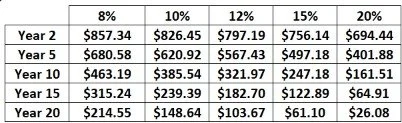
Discount rates have a significant impact on present value. In the above example, the $1,000 at an 8% discount rate is worth $214.55 today if held for 20 years. The same $1,000 at a 20% discount rate is worth $26.08.
So, when the discount rate moves from 8% to 20%, the second valuation is 88% lower ($26.08 versus $214.55).
Apply this to a critical minerals project. A company with strong financials, production expertise, and existing customers applies an 8% discount rate to a project while a pre-revenue mining company that has no revenue, production history, or customers doesn’t have that same luxury and must value the same asset 88% lower over the same timeframe due to the higher discount rate.
A 20-year window for valuation is not a stretch when you consider that it can take up to 29 years to develop and build a mine complex in the US. 20 years of negative cash flow must be made up for if and when the mine enters commercial production. You can see why generalist investors have fled the space for asset-lite cash flow generating technology companies.
Why is Cost of Capital a Constraint?
The availability of capital isn’t a constraint, but the cost, duration, and structure of that capital is. A lower discount rate can be achieved several ways including by derisking the revenue profile through binding offtake agreements and geographic diversity with a customer base. Clarity around these metrics allows lenders to correctly determine how much debt to lend to a company and on what terms.
Most critical minerals projects are focused on smaller markets with little pricing transparency. The inevitable result is a higher discount rate, supposing any debt package can be compiled in the first place. The ability to hedge price risk is almost nonexistent and this is “paid for” through higher rates. Most debt is not a realistic option, which means the company must approach the equity market and embark on an endless treadmill of shareholder dilution.
Until critical minerals markets can grow in size and become investable to a wider group of institutional investors, price volatility is a feature rather than a bug of this investment thesis. Investors that can withstand these risks and can deploy patient capital are likely to be rewarded.
What Deal Attributes Can Lower Cost of Capital?
You can see why price floors, despite the controversy, are helpful. The floor acts as a guarantee on revenue visibility. The MP Materials deal is the most obvious example, and we are still learning about the ultimate costs and benefits of this model. This was a mix of government-led equity investment, debt financing, and offtake which brough the private sector in the form of General Motors and Apple, in addition to a host of investors to the table. As no two companies are the same, no two deals will look exactly alike. That said, this deal offers a blueprint on how to achieve a lower cost of capital.
The Link Between Price and Capital
While it is cliché to say that nothing cures high prices like high prices, it has been proven true many times. High metal prices imply a lack of available supply and demand remaining robust. High prices entice investors to put their capital at risk and companies to devote CAPEX to both brownfield and greenfield expansion opportunities. This scenario has played out several times in recent years with critical minerals (lithium booms and busts in 2016-2018 and 2021-2024) and many companies typically decide to raise equity when metals prices (and share prices) are high. This is a great strategic move, despite benefitting from market timing. Unfortunately, when prices correct for any number of reasons, pre-revenue companies must raise more capital from the equity markets as the debt markets are effectively closed off. Dilution is the result as capital is raised at a depressed share price harming investors but allowing the company to survive for another day. Capital becomes more expensive as the price of metals declines.
The Underinvestment Spiral
The wealth destruction of past investment cycles has had two main consequences: underinvestment from a smaller pool of people and a higher cost of capital. While the datacenter buildout is forecast to continue, the pinches from both raw materials and equipment discussed in other Pillars will have an effect on the trajectory of this and other reindustrialization efforts. Copper mines must be financed, built, and brought into production in order to ensure electrification continues. Also, it’s not just capital needed for mine building, exploration dollars are crucial for the long-term discovery of more mine assets and this has been falling as well.
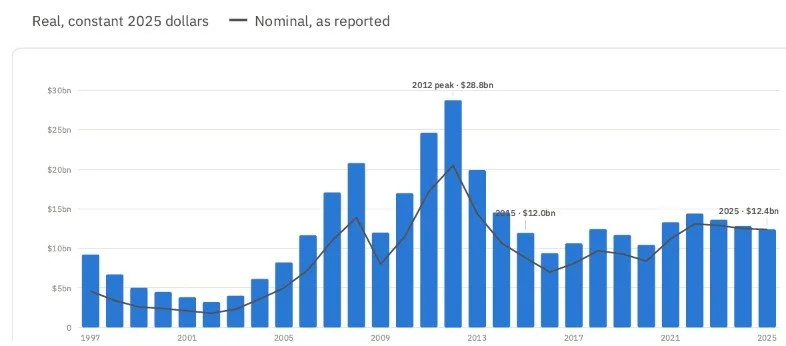
Source: S&P Global Market Intelligence: World Exploration Trends 2026
The above chart shows how the seeds of booms are sown. A lack of exploration and development capital can lead to a lack of new mines which serve as the building blocks of any reindustrialization effort. While budgets were certainly flush in 2012, that was the peak of that specific cycle and budgets have not returned to adequate levels. With much of the generalist investor class wary of metals investing, this has meant that those large pools of patient capital are harder and harder to find. Investors can have very long memories. This leaves strategic investors such as battery manufacturers or governments as the largest pools of capital alongside private equity infrastructure players who aren’t typical critical metals investors.
The consequences are smothered in irony. Underinvestment only prolongs the problem the West is trying to solve. With the time measured to build and scale critical minerals infrastructure in years, any lack of investment today means China maintains its grip on production and all the benefits that come with it including price setting.
This is why governments being involved in these markets is important even if it is not ideal. I’ve written about the idea that this can “crowd in” private capital and the jury is still out as to whether or not this has been successful. Investors have ample choice about when and where to invest and choosing not to invest in critical minerals is entirely rational, despite the strategic significance. Possible policy changes and price volatility mean investors employing a wait and see approach becomes the norm. It’s more valuable to “wait and see”. These issues plus investors being patient with their investments underpin a higher cost of capital for a given company and discount rate in any valuation exercise.
How Did China Do It?
The Chinese economic model has been successful despite operating under a hybrid version of capitalism. Many thought that China’s acceptance into the World Trade Organization (WTO) would encourage deeper integration of the Chinese economy into the world economy and free market economics would be the result.
As we now know, China is certainly integrated int the global economy, but on its own terms. This is not pure or traditional capitalism. China’s approach to critical mineral dominance is also a good case study. Given the historically low per capita GDP in China, the country’s leaders, starting with Deng Xiaoping, decided to employ a catch-up strategy where China would allow foreign companies to access the domestic market but at a price. That price was access to Western technology. Western automotive manufacturers would be allowed to set up shop in China but only under a JV structure. This strategy cut across multiple industries and in the case of critical minerals, much of the investment was internal or in markets in Africa where mineral access was effectively traded for domestic infrastructure.
Over the course of three decades, China has built structural dominance into its critical minerals supply chains. This has resulted in the Chinese cost of capital being so low that Western firms cannot match it. Chinese capital is priced differently due to state-led lending, subsidies, and lower rates which can deliver a single digit cost of capital.
The economic goals in China are also different than that of Western firms. While in the West, company-specific projects are optimized for maximizing returns while minimizing risk, in China entire supply chains are optimized for supply security which often leads to excess capacity. This excess capacity and the generally opaque nature of China’s economy at the provincial level are advantages in that they provide an implicit threat to any Western investor thinking of funding a critical minerals project. Could China flood the market with tungsten or lithium? Sure. Would they? Who knows. As we saw in the Pillar on Weaponization, China has learned to flex its muscles when it needs to.
So Western critical minerals companies are structurally disadvantaged on cost relative to China. In order to compete, risk must be shared amongst stakeholders or we must continue to develop a technological edge in the supply chain that preserves adequate margins. Viewed through this lens, the role of government in either shouldering or helping to transfer risk through mechanisms such as price floors or guaranteed off-take agreements is vital, like it or not.
The Bear Case
While I think it is unlikely that costs fall anytime soon, inverting the thesis here is worthwhile.
First, perhaps AI does deliver a productivity miracle and does so sooner than skeptics think. Real rates and discount rates fall in tandem, preserving project value and enticing skeptical generalist investors back into the critical mineral sector as the downstream productivity benefits outweigh higher structural costs.
Second, there are instances where capital can come back into projects faster than first thought. Brownfield projects could add to critical mineral supply faster, derisking the thesis and lowering discount rates.
Third, China’s spending binge and capital allocation decisions around excess capacity come back to haunt them as this capacity coupled with a significant debt overhang strands assets. This makes Western projects more valuable, especially when coupled with government-led backing.
Act II, Pillar IV will examine labor and skills as constraints
Act II, Pillar IV – Labor and Skills
Have We Been Here Before?
In Act I, I identified changing demographics as one of the forces impacting the reindustrialization thesis and critical minerals demand. As societies age and more workers edge into retirement, a younger cohort must replace them. This pillar looks deeper into the implications of changing demographics and its possible impacts on growth.
As much of the critical metals infrastructure has been offshored to countries like China, the West has lost something else: collective know-how. There is a reason China owns the refining step in the critical metals supply chain, and it goes beyond low cost of capital as I discussed. Chinese scientists, encouraged by the State, have spent decades perfecting the various processing technologies (for direct lithium extraction or rare earth element separation, for example) and while much of the process is not a state secret, this is another hill for industries in the West such as magnet makers to climb.
Meanwhile, here in the US, when we stopped building, that tacit knowledge has calcified. Like a processing plant, knowledge can depreciate over time. How can the West accelerate the buildout of the labor pool and build and enhance critical metals and associated technologies?
The Link Between Skills and Builders
At one point, the US was the largest producer of rare earth elements (REEs) in the world out of the Mountain Pass mine in California. The mine has been in and out of bankruptcy in recent decades and is fortunately back in business and vertically integrating its operation with the help of the Department of War, General Motors, and Apple.
While I won’t delve too deeply into the history of this operation, I do want to point out that the critical technology of not mining, but separating and purifying REEs was something done and perfected on US soil. When the mine went into bankruptcy in the 1990’s and was placed into care and maintenance, the REE business went to the low-cost epicenter of the world: China. The processing knowledge also went to China. As MP Materials expands its operation into full-blown magnet making, there is no book or three ring binder that says specifically how to mine and separate the material as each REE mine is unique with metallurgical, chemistry, and operating characteristics that don’t translate directly from one mine to another. MP has succeeded thus far through a process of learning by doing. This process of “getting your hands dirty” is how China came to dominate the critical metals supply chain ecosystem and it’s exactly what the West will need to do to build a parallel ecosystem.
Availability of labor is one thing; process knowledge is an entirely different and more pressing matter.
Pinpoint the Labor Constraint
Labor availability can be solved more easily depending upon the role. Certain types of labor that have transferrable skills are simply a price problem. Their services go to the highest bidder, and in the current environment with the datacenter build out increasingly important for the economy, jobs like welders, electricians, or pipefitters are increasingly in demand.
Other roles are harder to fill and aren’t simply a price problem. These more technical roles such as a chemical engineer or hydrometallurgist are more difficult to fill given the time it takes for an individual to “become” an experienced and qualified hydrometallurgist. Schooling and layers of experience in the field get one to the starting line. Finding a way to encourage more of today’s youth to pursue careers in these scientific fields should be a priority in Washington DC. Fortunately, there is movement here.
Time is a binding constraint. As it turns out, there are some things money can’t buy.
The Highest Bidder
That said, money can buy talent and the hyperscalers have made sure of this. With labor being a relatively small part of datacenter cost and tens of billions of dollars sunk in CAPEX, the ability and need to pay more than your competitor for construction work is no contest. Labor cost for a refinery is a larger percentage of the entire cost base and so there are limits to what a mining or refining company can absorb. So, either the labor pool expands to meet the demand and compresses wages, or parts of the reindustrialization ecosystem will be delayed through a lack of access to labor.
To be fair, this isn’t necessarily a black and white issue. This labor pinch is felt in areas where datacenter build out is concentrated such as Northern Virginia or Texas. In other parts of the country this pinch isn’t quite as acute but is still felt. The right question to consider is whether or not the right people can be hired, in the right location, at the right time for the right price.
The Role of the State
Previous Pillars in both Act I and II have discussed the need for government involvement to accelerate domestic supply chain development. While the Departments of War, Energy, and Commerce have all made investments of different types including loans, grants, and equity investments, this doesn’t solve the education or workforce issues discussed above.
Fortunately, the US Congress has considered legislation to fund these educational endeavors through legislation including The Critical Mineral Mining Education Act, The Mining Schools Act, and The National Critical Minerals Council Act.
Each of these pieces of legislation may have different specific goals, but the broader issue of building a workforce with the requisite skills and intellectual know how to compete is the main thrust. It is too early to gauge the success of these bills, as said above, success will be measured over years.
Putting taxpayer capital in a bazooka and blasting it at projects of high strategic value is important and necessary. But supplying the workforce to build and operate this infrastructure is more important.
Another Way: Immigration
In addition to education as a priority, immigration and attracting talent from offshore should also be priority. Mining education interest can be just as cyclical as the metals cycle itself, so there must be another valve to turn on to attract talent.
Immigration is the answer. Rather than drawing from a small, domestic pool of expertise, it makes total sense to look abroad for those specialized roles such as solvent extraction experts. Other mining-centric countries like Canada or Chile have expertise and there’s no reason not to encourage this talent to immigrate.
Unfortunately, immigration, one of the great historic strengths of the US, has become a toxic issue with many able and capable minds rethinking working in the US given the headaches now imposed with compliance. Additionally, the visa system in the US (H-1B) and compliance costs have been politicized and have a limit as well. It’s depressing to see such a relatively easy fix thrown away here, but the political winds in the US are blowing in such a way that it’s hard to see how immigration can ride to the rescue of this domestic skills gap anytime soon.
A final note underlines the need for labor with the right skills, right now. A number of the mining/refining assets targeted by governments are strategic in nature. Mountain Pass is a vertically integrated REE mine-to-magnet company. Given the national security and intellectual property concerns here, one must assume that only domestic labor without ties to foreign adversaries is eligible for the job. The security sensitivities here restrict who can be involved, potentially shrinking the total available labor pool.
The Bear Case
First, in keeping with the potential impacts of AI and productivity on the economy, perhaps a wave of automation comes for the critical minerals sector sooner than we think. The labor shortage is solved. Or is it? While this may mean less absolute need for labor, the skill set will evolve meaning engineers and experts in robotics or data science become in demand, possibly shifting the labor deficit.
Second, intellectual property and process know-how can be accessed through cross-border partnerships or joint ventures, also known as technology transfer. This takes time and money and may or may not be a good cultural fit between partners but could add erode labor scarcity in certain sectors.
Third, datacenter moratoria and overinvestment combine to slow the pace of datacenter growth. This may take the pressure off of labor availability given that the datacenter CAPEX cycle is integral to economic growth.
In Act II, Pillar V, we examine resource nationalism as a constraint.
Act II, Pillar V – Resource Nationalism
Governments Get Aggressive
Resource nationalism is broadly defined as governments taking greater control of natural resources on its own sovereign territory ahead of private interests. The main goal is to capture more of the economic value along the supply chain as opposed to offshoring the value.
As we have seen, governments are more involved than ever before in the development and allocation of domestic resources. Resource nationalism is nothing new and usually enters the headlines when resource prices are at or near a high. It has become increasingly clear to governments that critical materials are at the epicenter of technological (and economic) growth today and in the future. Because of this, government involvement in these markets in traditional and new ways is likely to become the norm. In other words, resource nationalism will be a permanent fixture of the critical minerals ecosystem moving forward.
This is due in part to the obvious strategic nature of these materials, but also due to the fact that governments have realized that materials like lithium, cobalt, or copper are the sine qua non of economic and national security supply chains.
The definition of resource nationalism has broadened as governments are using new tools to assert control. The chart below indicates what is and isn’t considered to be resource nationalism today.
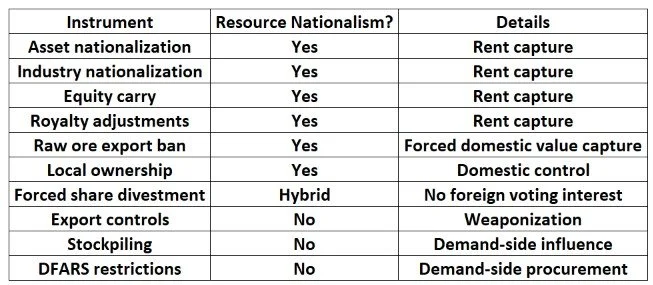
The key in determining what qualifies as resource nationalism is the goal of the policy. If domestic value capture is the end game, then this is traditional resource nationalism. Look at Chile and the royalty regime with lithium or Zimbabwe and that government’s determination that raw lithium ore exports are banned until foreign mining companies (mainly Chinese) build conversion capacity onshore. These moves are designed to capture more of the value added with the local populace as opposed to offshoring low value materials and upgrading them elsewhere.
The toolkit has broadened. Export controls and licensing of materials are a hybrid form of resource nationalism in that these acts are designed to deny trading partners access to critical materials where a supply chain may be concentrated. Good examples are gallium and germanium, two critical materials that are tiny markets with gallium at 1,700 tonnes and germanium at 230 tonnes according to the USGS. Both are dominated by China. China doesn’t necessarily gain anything from these export restrictions in the same way a higher royalty rate or deeper domestic vertical integration would benefit the country and its citizens but can exercise leverage here to bargain for advantages in other sectors such as semiconductors. In fact, export controls could hasten the build out of supply chains globally.
Regardless of how these policies are defined, there’s a new player at the table looking at critical materials through a lens of must-haves for economic growth and national security.
What Hath We Wrought?
Governments demanding a fair deal with companies doing business in country is not a new phenomenon. Whether or not companies are individually forced to renegotiate contracts or entire industries are nationalized, there is a long and largely unsuccessful history of governments “moving the goal posts”. The irony is that once a government starts making new demands, this can scare away additional capital and when the capital leaves, so too does the technical and intellectual capacity.
With the US and China racing to try and untangle intertwined supply chains, this puts non-aligned producers in countries like Chile, Indonesia, or Zimbabwe in a unique position. They don’t have to choose sides and have significant leverage in terms of dictating the terms of any financial arrangement. This new dynamic is a consequence of many of the forces discussed in Act I and a main reason why geopolitical risk has grown in importance and must be priced by investors and companies alike.
The Spokes of Leverage
Given the new power that countries have to set terms, it is worth considering what the foundations of this leverage are. This is not commodity-specific but risks across commodity, industry, and country must be accounted for. These spokes include:
· Commodity concentration – Is a raw material sourced mainly from a single region? Cobalt from the DRC would be an example here.
· Supply chain concentration – How much of a given supply chain is in a specific region. China looms large here.
· History – Does the country in question have a reputation for asset expropriation. Bolivia or some African countries are examples.
· Substitutability – This may weaken the case for resource nationalism as the ability to substitute one material for another may weaken the home country leverage.
· Operability – Should a country become an asset owner and operator, does it have the homegrown talent to do so?
Ranking countries in their supply chain leverage and ability to enforce their will can be a subjective exercise. That said, in the interest of a thorough analysis, I have tried to do this below. Six dimensions are scored on a scale of 1 to 5 from weakest to strongest leverage. Concentration and position of supply chain are designed to be data-based while the other criteria are somewhat subjective. This is not designed for absolute precision or forecasting. You can think of this as a due diligence tool.
Each variable scored 1 to 5, highest leverage darkest. The supply share column carries its sourced figure; every scored column except concentration and chain position is an assessment.
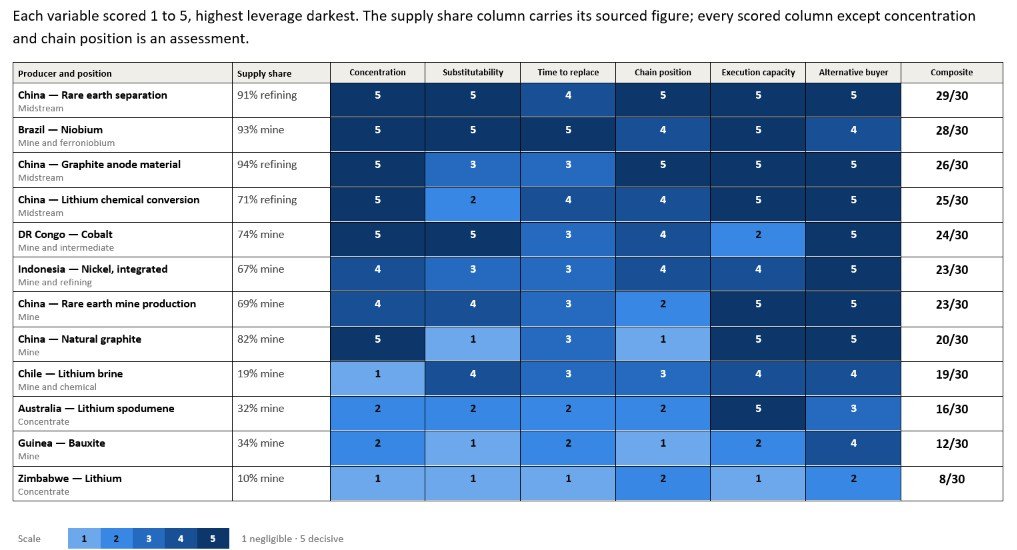
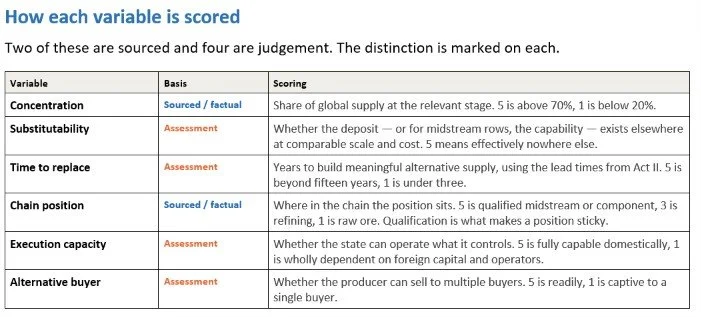
Execution Equals Results
This data is important. It’s one thing for a government to expropriate assets or impose export restrictions. It’s an entire other thing to become an actual owner/operator of a mine or refinery. The inability to execute leads to a stranded asset due to a lack of customers, fewer jobs, lower tax revenue, and less capital availability. The ultimate goal of building a domestic supply chain vanishes.
Indonesia has announced raw nickel ore export bans in the past until a domestic processing piece was built (by China). This has been widely seen as a success as the export bans encouraged Chinese producers with sunk capital in the country to double down and expand nickel supply chain capabilities.
Zimbabwe has announced a similar plan with lithium but hasn’t had widespread success (yet) in convincing mining companies there to build lithium processing capacity. A refinery can take several years to build, ramp up, and hit full commercial run rates.
Dictating a policy is one thing, but governments must remember that these mineral development projects are partnerships. While the government effectively “provides” the asset, the mining company brings capital and expertise. These factors all need to work in tandem.
A Brief Note on Divestment
Resource nationalism isn’t limited to assets in the ground. In recent years, we have seen the governments of Canada and Australia order Chinese shareholders of Western critical minerals companies to sell their stakes. Australia’s FIRB reviews and in the US CFIUS reviews are not unlike what the government of Indonesia did with its nickel industry by allowing government to dictate who can and can’t participate in domestic commerce. While this is more about security than value extraction, these review boards and forced selling of shares are weaponization under a different name.
The Effect on Pricing and the Discount Rate
Interference in markets can impact both prices paid and returns generated. I will discuss the impact of bifurcated markets in Act III, but it is important to know that export bans, a form of resource nationalism, create two-tiered pricing structures. Look at tungsten as an example.
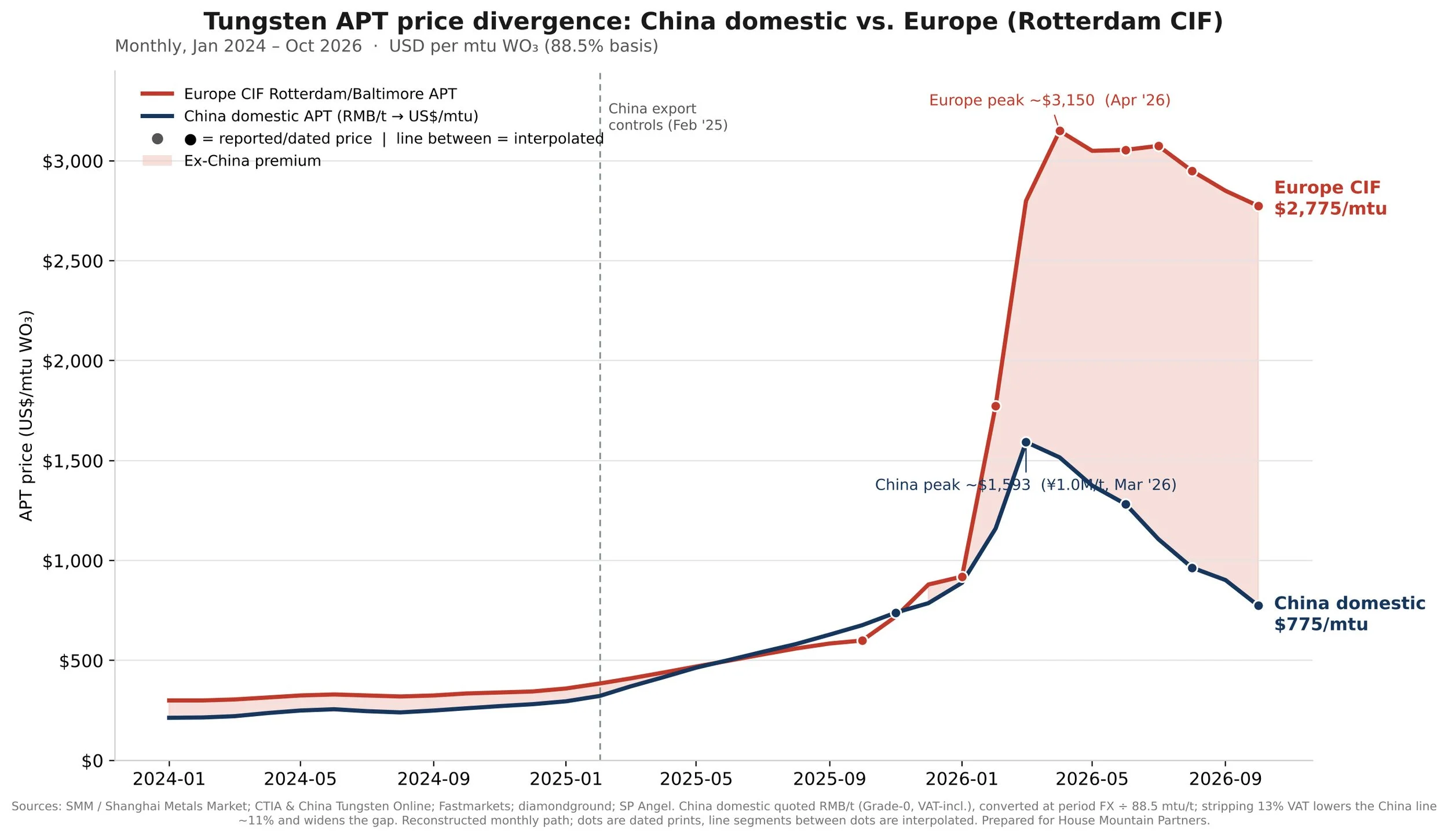
This is an example of two prices for the exact same product in two different markets. Is this efficient markets at work? It is assumed that once a country that forces vertical integration of a metal supply chain has succeeded, prices will converge.
It is too early to tell how soon this will play out, if at all. Security premiums and generally higher cost structures may permanently establish two-tiered markets for certain strategic commodities. Recycling, new capacity, and substitution could hasten this convergence but price discovery in the interim is the casualty. This raises a crucial point: strategic importance and higher pricing do not necessarily deliver higher risk-adjusted returns. Each project is unique in that investors must decide if returns from strategic supply that is protected by a government outweigh the higher cost of capital and execution risk that come along with it.
The Bear Case
Resource nationalism always has been and likely always will be a fact of life for serious critical material investors. This makes any bear case somewhat hard to defend. That said, here are some reasons for optimism.
First, resource nationalism may remain a cyclical phenomenon. Once metals prices fall back to earth, perhaps governments will loosen their grip on the assets as economic prospects aren’t as promising.
Second, governments making threats has a direct effect on the cost of capital. The idea that it is inherently riskier (expensive) to do business in a country based on the whims of government is valid. The desire to extract rents from companies can lead to a lack of building in the first place.
Third, the track record of countries coordinating production to control the flow of output is almost non-existent. An “OPEC for lithium” has been discussed many times but never moved forward due to a host of factors including no previously workable model, anti-trust concerns, and the general small market size and pricing opacity that end users would all strongly object to.
Fourth (and this is an enormous stretch), perhaps the US and China are able to come to a détente and the leverage that countries had in terms of playing the US and China off one another vanishes.
On to Act III where we examine Value Capture through pricing, counterparties, financialization, and supply chain winners and losers.
Act III – VALUE CAPTURE
Introduction
After reading through Act I to determine what has changed in the global economy and Act II which discussed the constraints to growth, you may be asking the question, “So what?”
Act III aims to answer that question. The Pillars here will look at who is poised to earn the returns and why. Acts I and II made the argument that despite technological advances, more, not less, critical materials will be needed and consumed. This will be done at a higher cost structure, and profitability is not a given. Just because the macroeconomic backdrop has changed and there are roadblocks to growth doesn’t mean by default that all market participants such as taxpayers or companies will generate positive returns through investment cycles.
Just because something is scarce doesn’t mean it is profitable to produce. These concepts are different in that while a shortage tells you price must rise, value capture or a positive return on invested capital are not a given in an era of scarcity. The ability to tailor a deal to the unique market structure of critical minerals (small tonnage, opaque pricing, no ability to hedge) is a major determinant of returns over a cycle. The ‘tyranny of geology’, a concept I mentioned in an earlier Pillar, is a unique factor here and is also a major factor for positive returns.
The Breakdown Between Returns and Scarcity
There is ample evidence to make this claim and studying the lithium market boom and bust from 2020-2024 is instructive. When COVID took hold of the global economy in 2020, lithium share prices collapsed given the growth uncertainties. Demand continued to power forward almost oblivious to the macroeconomic uncertainty through 2024. Strong volume growth despite a price collapse is the disconnect. Steady demand, coupled with repeated challenges of bringing supply online should have meant that lithium pricing was immune to these challenges. While lithium carbonate pricing did rise from roughly $6,000 per tonne to over $80,000 per tonne in 2022, economic reality did eventually set in and prices crashed, taking lithium company share prices with it. Projects that were economic at these unsustainably high prices were put into care and maintenance. That capital was gone forever. At $80,000 per tonne the entire global lithium cost curve was robustly economic. Something had to give, and it did. Demand growth and shareholder returns went in opposite directions. In critical minerals, the price of the metal usually leads the equities. In this case, that was true both on the way up and the way down.
Overcoming the Constraints
Act II laid out the constraints to growth including power, cost of capital, skills, and resource nationalism. None of these (except possibly power) can be bought; they must be managed. Power scarcity is a problem and so to solve this you need to own generation capacity and equipment. Labor and skills scarcity is a problem, and you must invest in training initiatives to develop the talent and intellectual property that makes your investment unique among many. Delays caused by permitting, equipment access, or construction can affect returns though extended cash burn and could harm a company’s balance sheet strength. Resource nationalism presents a unique challenge that requires diplomatic tact, domestic investment in labor and infrastructure, and a dose of good luck.
Identifying these constraints allows you as an investor to determine who can solve them and how.
Act III has four Pillars that look at critical minerals supply chains and try to answer who generates returns and where.
The first Pillar examines pricing for critical metals such as tungsten which has bifurcated between a domestic China price and an ex-China price set out of Rotterdam. Two prices for the same molecule. One is set by Chinese industry cost structure and the other is set by scarcity ex-China. Both prices are higher than they likely should be given the hype around critical minerals. Will this pricing gap persist or converge as the cycle matures? How inelastic are prices outside of China?
The second is whether it is realistic to assume that Western governments will backstop critical minerals projects in perpetuity? A price floor is necessary, but this is a policy choice rather than an operational move. Returns are dependent on answering this question.
Third, where do the returns along the supply chain actually flow? The processes that are most complex are not always the same processes that generate the highest returns. Mining, refining, battery or magnet component manufacturing all have different margin profiles that can vary based on a host of factors including geology, customer validation, and the consistency of policy.
Fourth is a Pillar devoted to the overall bear case where I try to refute the arguments. Some of this may be repetitive.
Is it “different this time”? In some ways, perhaps. The impact of technologies like AI is still being debated and the outcome is crucial for the critical metals complex and risk-adjusted returns. If private capital doesn’t continue to come into the sector, the undersupply thesis can become structural, and it appears certain metals are headed this way including lithium and copper.
To be clear, commodity investment cycles are not going away, but the severity both to the upside and downside can be managed. This can be accomplished through a dose of accommodative government financing, guaranteed offtake agreements, and a deeper forward curve which may pique the interest of the generalist investor.
What’s Next?
At the end of reading this document, the reader should be able to look at any specific critical minerals opportunity and diagnose which trends are influencing the opportunity and which constraints are holding it back. The Value Capture Map in Act II should be particularly useful.
Act III, Pillar I examines Bifurcated Pricing and the security premium.
Act III, Pillar I – Bifurcated Pricing and the Durability of Premiums
One Molecule, Two Prices
The era of a single price for most critical minerals is over. Pricing is determined by more than just supply and demand. A single, global price must satisfy three conditions. First, the product must be fungible. To be fair, in most cases, critical minerals are not entirely fungible and can differ based on purity levels which can drive a pricing differential. However, the spreads we see in the current market for certain rare earths or tungsten go beyond purity differences. These spreads are policy-driven.
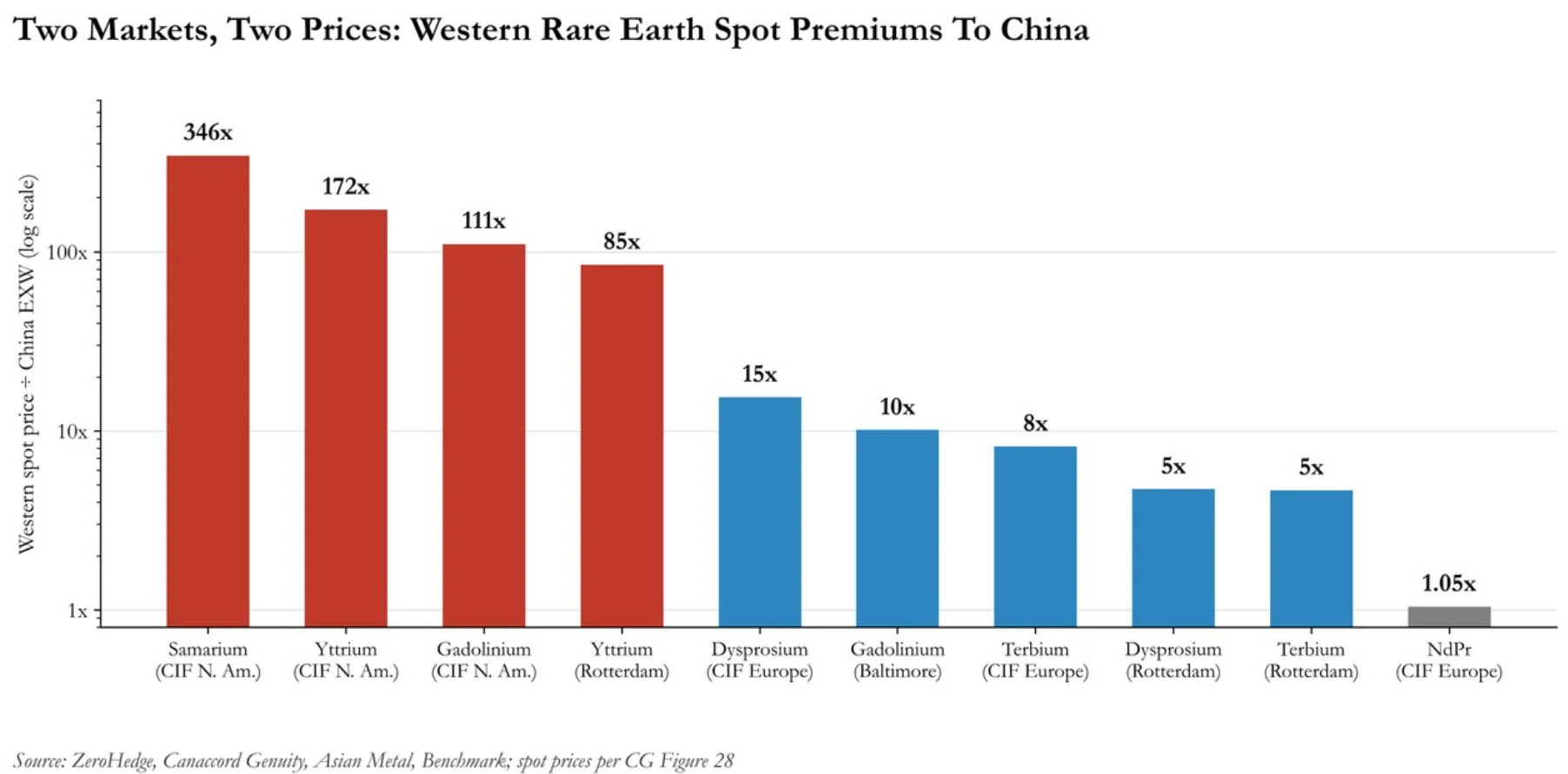
The chart above demonstrates how pricing can be structurally different when politics is at play.
Aside from fungibility, a single price requires buyers who can purchase material of different origin, and arbitrage. As the forces in Act I took hold, these criteria all broke down. This Pillar discusses what happens next.
The price premium in Western markets is not uniform across different critical metals which complicates true price discovery. In addition, demand for certain materials can be highly inelastic as end users such as defense manufacturers must have the materials in the right quantities, at the right purity, and at the right time. China knows this, which is why the export controls and licensing regime for certain critical metals is likely a permanent feature of the investing landscape until Western players can build comparable infrastructure – measured in years.
Given that this price premium is not easily hedged, the cost of capital for a Western producer may be structurally higher. This is a point I made in Act II, but it bears repeating as the higher cost structure could impact returns. End users will pay what they must (for now), but for companies building mines or refineries, they must convince capital providers that they can make money not at current high prices, but at a range of prices. The higher cost structure calls this ability into question and underlines the need for a government backstop.
How Did We Get Here?
While an entire book could be written on the history of commodity markets and the evolution of pricing, I’ll make just a few points on how we got here.
First, origin matters. Historically, chasing the lowest cost of production or cheapest product meant that as a buyer, you ended up in China. With a 30-year head start on building vertically integrated critical material supply chains, the “China price” became the single price to meet or beat. Given the geopolitical tumult of recent years with export controls, tariffs, CFIUS reviews, DFARS requirements, and FEOC requirements, proving the origin of your battery/magnet/drone/etc became a requirement. This is part of the entire critical materials investment thesis that is still playing out, but the byproduct has been to create two prices for the same material. Again, Neodymium-Praseodymium oxide (NdPr) or Ammonium Paratungstate (APT) tungsten are two examples already discussed.
Second, while the first cause of the price bifurcation was political, the second was market-based. Marginal cost suppliers inside and outside China operate at quite different cost structures and those cost structures can even differ within borders, so finding a single low-cost producer can be challenging. Sustained profitability is the goal regardless of where a producer is located, but in China a structurally lower cost of capital and state and province-level directives on productive capacity put the rest of the world at a competitive disadvantage. Western producers must be able to generate an acceptable return above the cost of capital accounting for labor, power, permitting, and other inputs before policy is considered.
Sustained profitability is important for obvious reasons, but understanding exactly why two prices for the same material differ can tell you how much of that price is subsidy-driven and how much is market-based.
Durability
It is worth considering whether bifurcated pricing is durable or not. If not, what can erode the chasm between pricing? This is important as no two critical materials are alike and the reasons for price durability in one example might differ from that of another critical material.
Price durability is underpinned by product qualification, mandated procurement rules, and provenance.
Regarding qualification, the time and cost associated with re-qualifying a new supplier of permanent magnets, for example, can take years (perhaps 24 months or more). No procurement manager wants to take this risk with time or capital on a potential new supplier. As a result, the procurement manager will pay whatever they have to ensure delivery of reliable material.
Mandated procurement rules such as the Defense Federal Acquisition Regulation Supplement (DFARS) state that an increasing number of components cannot come from or pass through certain countries such as China. There is a clock running here starting on January 1, 2027, and it remains to be seen just how much of Western critical mineral supply chains are ready. Many waivers are expected in the near-term as the readiness of Western supply chains is about to be put under a microscope.
Finally, provenance can support a price premium. Criteria like mass balance and chain of custody can lock in the structurally higher price for certain buyers, benefiting the producer at the expense of the consumer.
Factors that could erode pricing differentials include transshipment, Chinese market manipulation, waivers and exemptions, and substitution.
Transshipment is perhaps the most popular way around the structural price difference and is akin to whack-a-mole with the US government increasingly trying to prevent materials from China shipped to a country like Vietnam, upgraded there, and then labeled as ‘Made in Vietnam’. This is happening more frequently due to the effects of the Trump Administration tariffs.
Chinese market manipulation really focuses on dumping cheap or uneconomic material on the market, suppressing the Western price and rendering critical material infrastructure unbuildable due to poor economics. Government policy could change this dynamic somewhat, but its efficacy remains to be seen.
Waivers and exemptions don’t solve any problems in the long run but kick the can down the road. On the upside, these waivers and exemptions can allow companies more time to build out their supply chain infrastructure or consider alternative sourcing strategies. China has a multi-decade head start on the West and this won’t be fixed soon.
Finally, substitution and thrifting are always considered as the most immediate fix to the issue of critical material dependence, but building out this infrastructure takes time and money. That said, over time, this could have a downward effect on pricing.
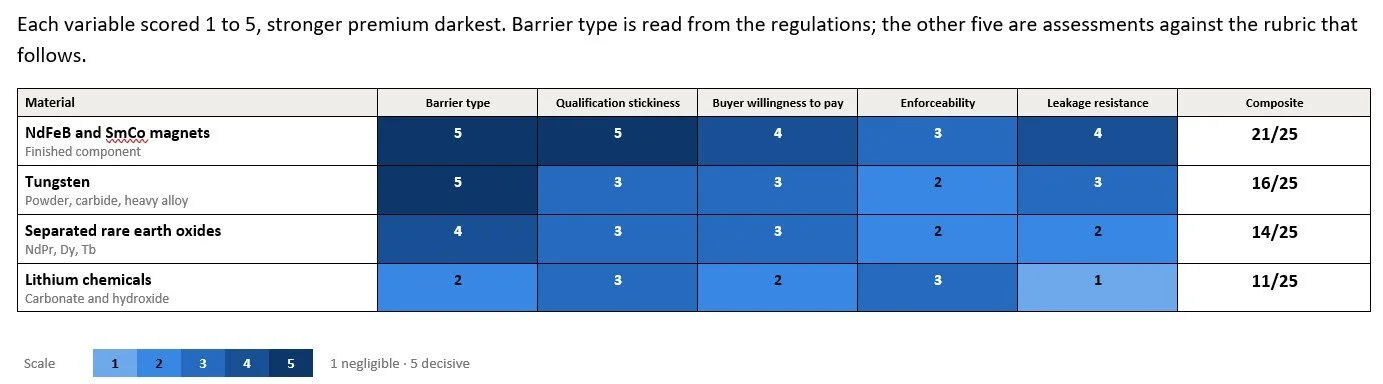
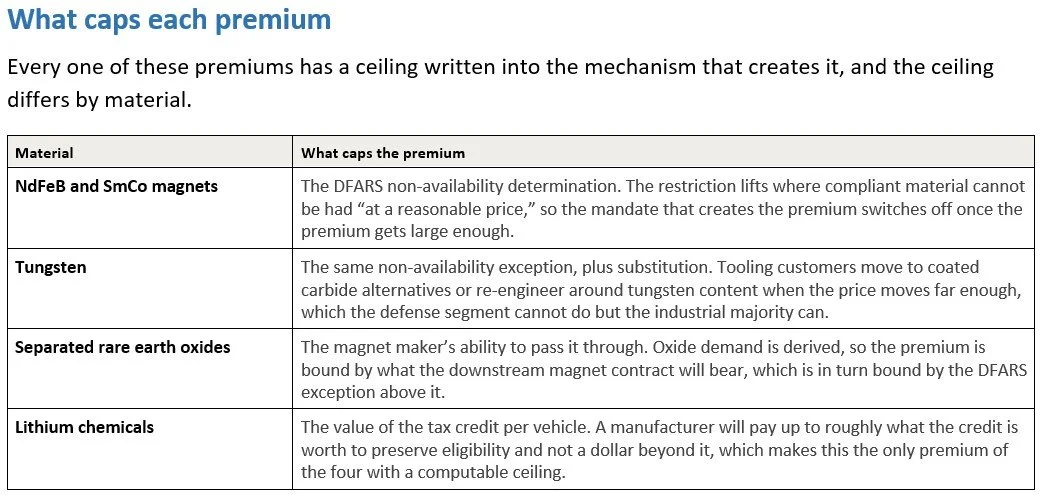
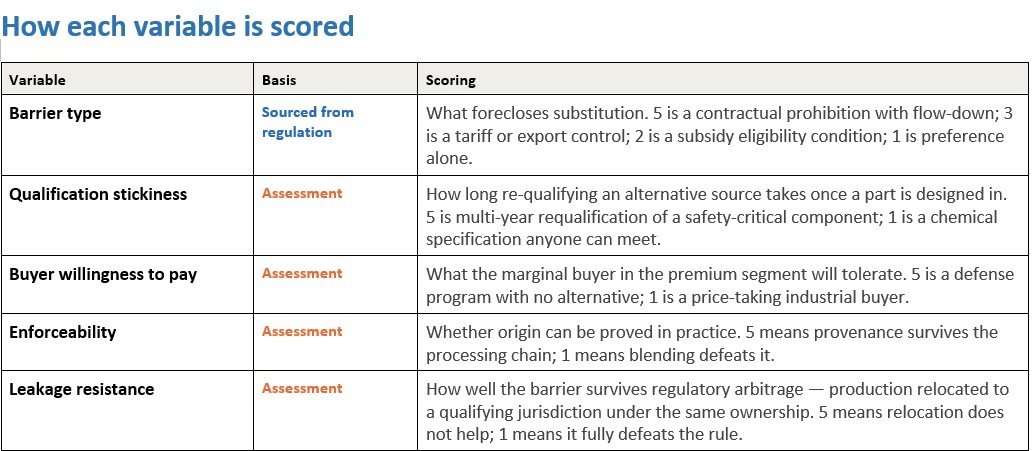
Price Discovery and Hedging
This has been discussed previously, but even before certain critical material markets experienced bifurcated pricing, the ability to determine a “true” price and hedge against the risk of volatility was almost nonexistent. Price discovery came through price reporting agencies (PRAs) or publicly available import/export data. The credibility here was always an issue as some of the critical material markets are thinly traded, making pricing a backward-looking endeavor. Additionally, an inability to hedge price risk means that price risk is something confidentially negotiated between buyer and seller in an offtake agreement. Those details can vary from one deal to the next. It is true that financial innovation in critical materials has started to take hold with lithium, cobalt, and tungsten futures contracts but more contract liquidity and a focus on a non-China price is needed. A price premium that can’t be hedged can raise significant revenue (good) but does so at the expense of a higher cost of capital (bad).
So, the broad exposure to price risk is a feature rather than a bug in Western markets unless you are directly involved in a deal and can find a way to either transfer or share the price risk.
Cui Bono?
Value capture will be discussed later on in Act III but the real beneficiaries of the market structure I discussed above are existing and qualified producers with binding contracts in place that are ideally indexed to the Western price. Other winners in the current environment include any player holding critical mineral inventory, traders with the ability to move compliant material, and toll processors that have proven technology at reasonable scale but don’t have to take commodity price risk.
The list of stakeholders who would not benefit from bifurcated pricing is much larger with the largest cohort being the next generation of suppliers, not yet in production and struggling to raise capital at a higher cost without a scaled product or a varied customer base. Some, but not all of these pre-revenue companies will be needed in the future but must find a way to cross the chasm to even get close to a production decision. These companies are asymmetric bets.
Perhaps the biggest constraint here is that while a higher Western price is mostly inelastic, this varies widely by industrial end user. Defense buyers like Lockheed Martin will pay a premium but are not a high-volume purchaser. Automotive OEMs are high volume purchasers but are reticent to pay up. So, the premium price we observe from a PRA and the actual price a Western producer receives can be different based on the volumes purchased at a specific price. How should a bank price a financing based on this pricing anomaly? The premium can also differ based on specific end product. Rare earth permanent magnets seem to have a durable premium whereas lithium carbonate does not.
Government to the Rescue as Market Maker
In the previous section I asked how a bank is supposed to price a financing package based on the current pricing architecture. This is where governments can and are getting involved. In fact, it is government that is responsible for price bifurcation in the first place thanks to export controls, tariffs, and other diktats.
Despite this, government, through these instruments and others such as price floors, can single-handedly make a Western critical minerals project bankable. A price floor helps to ensure a steady revenue stream. The NdPr price floor with MP Materials is a terrific case study in how this should work. Other tools like tariffs and stockpiles also act as price stabilizers, though there are cons to these tools as well.
The main drawback is that these are policy tools. What government giveth, government can taketh away. There is no guarantee that price floors, tariffs, and export controls will stay in place as the political class changes over time. This should remind you of the timing mismatch discussed in Act II around financing an asset like a mine with a 30-year life while the policy has a much shorter fuse.
The Bear Case
Though it looks like this two-tiered pricing environment is a new structural feature of the macro environment, this could morph into something else. Here are a few reasons to consider:
First, a benchmark price based off thin volume may not maintain the credibility needed to base contracts off of. The “true” price may be embedded in contracts off limits to the broader market.
Second, the price premium sows the seeds of its own destruction through substitution, thrifting, and product innovation or redesign.
Third, if a premium were durable, capital would have already been deployed to capture the outsized returns. Lithium at $80,000 per tonne didn’t last and current price premiums for metals like tungsten may not either.
Fourth, politics can change and the removal of export controls or price floors could reset the global balance for critical materials.
In Act III, Pillar II we look at government as a counterparty.